
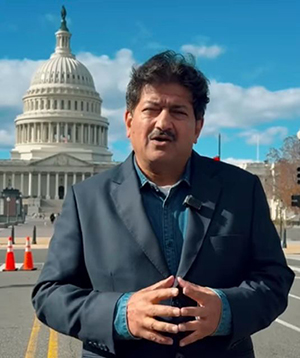
Hamid Mir
Allama Iqbal could never have imagined that the very city where, in 1930, he demanded the establishment of a unified Muslim state for the Muslims of India would have its Muslim name erased thereby validating his own apprehensions regarding the identity of Muslims. Every year, on November 9th Iqbal Day commemorative events invariably reference Allama Iqbal’s Allahabad Address; it was this very address that earned him the title of the “Architect of Pakistan” (Musawwir-e-Pakistan). On December 29, 1930, the All-India Muslim League held its annual session in Allahabad. In his presidential address, Allama Iqbal stated that the Hindu leadership had formed a nexus with British imperialism a nexus that posed an existential threat to Islam and the Muslim community. Consequently, he argued, Muslims would need to establish a separate state to counter this danger
. In 1947, this state Pakistan was established. Yet, even today, the extremist Hindu leadership seeks not only to erase the existence of Pakistan but also to extinguish the religious identity of the millions of Muslims living in India. Yogi Adityanath, the Chief Minister of Uttar Pradesh notorious for his hostility toward Islam and his role in the demolition of mosques has not only renamed Allahabad to “Prayagraj,” but recently, while speaking in the Uttar Pradesh Legislative Assembly, he also criticized Allama Iqbal, holding him responsible for the partition of India.
In the government schools of Uttar Pradesh, the recitation of Allama Iqbal’s famous poem, “Bachay Ki Dua” A Child’s Prayer), has been banned. Banning Allama Iqbal’s poems in Indian schools or removing his works from the curricula of Indian universities does nothing to diminish the stature or standing of the ‘Poet of the East’ (Shaair-e-Mashriq). On the contrary, such actions only serve to highlight that Allama Iqbal was a great benefactor to the Muslims of this region. He moved on from ‘Tarana-e-Hindi’ (The Song of India) to compose ‘Tarana-e-Milli’ (The Song of the Muslim Community) precisely because, as early as 1930, he foresaw the very threat to Muslims that the entire world is witnessing today manifested in the anti-Islam policies of Narendra Modi. It is a cruel irony that, while extremist Hindus in India loathe Allama Iqbal simply because he proposed the concept of a separate Muslim state in his Allahabad Address, there are also certain Pakistani intellectuals whether consciously or unconsciously who continue to sow confusion regarding the Allahabad Address, aiming to sever the link between Allama Iqbal and the very concept of Pakistan. A professor from Quaid-i-Azam University recently sent me an article authored by a London-based banker named Yousuf Nazar and published in “The Friday Times” on October 29, 2026, insisting that a rebuttal is essential, as yet another attempt has been made to decouple Iqbal from the concept of Pakistan. I remarked to the professor that the piece contains nothing new; it merely recounts the old debate between Allama Iqbal and Edward Thompson a subject on which I have already shared my thoughts quite recently. When he persisted, I suggested, “Why don’t you write a response this time?” He remarked, “I am a government employee; if I were to highlight the true spirit of the Allahabad Address, my job would be at risk.” I asked, “How so?”
As you are aware, the Allahabad Address identified not only the nexus between British imperialism and Hindu extremism but also ‘Arab imperialism’ as a threat to Muslim identity. Professor Fateh Muhammad Malik previously lost the rectorship of a major public university after discussing this very subject; therefore, I shall not take such a risk. Those astute observers who argue that Allama Iqbal did not envision a separate state, but rather a Muslim province within an Indian federation, overlook several crucial facts. The most significant of these is the full text of the Allahabad Address. A careful examination of the complete text reveals that, in this address, Allama Iqbal was, in effect, defending the ‘Fourteen Points’ of Quaid-e-Azam which the latter had presented in March 1929.
The first point stipulated that India’s constitution should be federal in nature, while the second proposed that all provinces be granted equal internal autonomy. Quaid-e-Azam was advocating for the rights of Muslims while remaining within an Indian federation. Now, consider these words of Allama Iqbal from the Allahabad Address: “I would like to see the Punjab, North-West Frontier Province, Sindh, and Baluchistan amalgamated into a single state. It appears to me that the formation of a consolidated North-West Indian Muslim state whether it attains autonomy within the British Empire or outside of it is the ultimate destiny of the Muslims of North-West India.” Furthermore, Allama Iqbal stated: “I am demanding the establishment of a consolidated Muslim state for the welfare of both India and Islam.” “This would establish a balance within India and provide Islam the opportunity to free itself from the influences imposed upon it by Arab imperialism.”
British Prime Minister Ramsay MacDonald was deeply displeased by this proposal for a Muslim province within an Indian Federation, his displeasure was reported by more than one newspaper. Edward Thompson, a British intellectual sympathetic to the Congress, also levelled harsh criticism against Allama Iqbal’s proposal. The clarification Allama Iqbal offered to Thompson was framed within the context of the Quaid-e-Azam’s Fourteen Points. In 1934, he clarified that there was a distinction between the proposal he presented in his Allahabad Address and the ‘Pakistan Scheme’ put forward by Chaudhry Rahmat Ali. Allama Iqbal had delivered his Allahabad Address in his capacity as the President of the Muslim League, remaining within the bounds of party policy though, personally, he did not wish for the Muslim-majority regions to remain part of an Indian Federation. He was, in fact, pursuing a political strategy aimed at a gradual progression toward independence.
Chaudhry Rahmat Ali had presented his ‘Pakistan Scheme’ in 1933 in consultation with Allama Iqbal. During a meeting in London in 1931, Chaudhry Rahmat Ali had asked Allama Iqbal what a state formed according to the proposal outlined in his Allahabad Address would be called. In response, Allama Iqbal suggested taking the first letter (or syllable) from each of the provinces of northwestern India and combining them with the ‘tan’ from Baluchistan, this would form the word ‘Pakistan’ a highly meaningful and excellent term. In his book Iqbal ka Tasawwur-e-Millat aur Azadi-e-Hind (Iqbal’s Concept of the “Millat” and the Freedom of India), Dr. Irshad Shakir Awan recounts this episode, citing Abdul Wahid Khan to whom Allama Iqbal himself had narrated the details of his conversation with Chaudhry Rahmat Ali in Bhopal in 1935.
Maulana Syed Abul Hasan Ali Nadwi (Ali Mian), the former head of Darul Uloom Nadwatul Ulama, writes in his book Naqoosh-e-Iqbal* that when he met Allama Iqbal in Lahore on November 22, 1937, Iqbal stated that Pakistan was the sole solution to the problems faced by Muslims. Although the term ‘Pakistan’ did not appear in the resolution adopted at the Muslim League session on March 23, 1940, the word frequently featured in Allama Iqbal’s own discourse a fact supported by abundant historical evidence that cannot easily be erased. Today, by demolishing mosques and renaming Allahabad, the BJP in India has effectively vindicated Allama Iqbal’s foresight. However, in Pakistan, merely observing a public holiday on November 9th is insufficient to truly honour Iqbal, the Pakistani state must also considering the Allahabad Address steer itself away from autocracy, imperialism, subservience to imperial powers, and extremism.
