
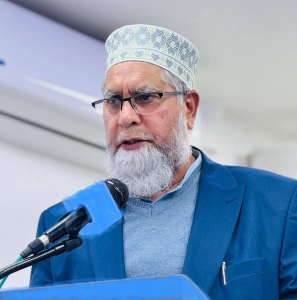
Prof Masood Akhtar Hazarvi
Today, out of the world’s total population of eight billion, nearly one quarter consists of Muslims living across 57 Muslim-majority countries. In other words, according to a cautious estimate, the global Muslim population stands at close to two billion people—inhabitants of regions endowed with the world’s most valuable resources and a uniquely strategic geographical position. The encouraging aspect is that these lands are rich in oil, gas, gold, uranium, and rare minerals. Situated at the crossroads of Asia, Africa, and Europe, Muslim territories connect major global trade routes. Their greatest asset is a vast and youthful population.
Yet a deeply painful question arises: despite such immense blessings, why do we lag so far behind the world in knowledge, ethics, economics, politics, science, and technology—when there was once a time, witnessed by history itself, when this very Ummah led the world intellectually and morally?
From the eighth to the thirteenth century CE—the era known as the “Islamic Golden Age”—Muslim civilization authored some of the brightest chapters in human history. Baghdad’s Bayt al-Hikmah, the libraries of Córdoba, the scholarly centers of Granada, and the universities of Cairo and Damascus opened new horizons of learning and research. Thinkers such as Al-Khwarizmi, Ibn al-Haytham, Jabir ibn Hayyan, and Ibn Sina reshaped the landscape of human knowledge. Their teachings illuminated Europe’s Dark Ages. Regrettably, that light did not endure. Mongol invasions and political fragmentation devoured this civilizational ascent. Europe rose through the Renaissance, while the Muslim world slipped into stagnation.
Today, our greatest decline lies in intellectual and scholarly weakness. Muslim countries spend only a negligible portion of their national output on research and development. In modern universities, examination-oriented systems prevail over critical and creative thinking—producing degrees, but not minds capable of raising new questions. This is why Muslim representation in scientific Nobel Prizes is almost nonexistent. Ignorance has bred division, and sectarianism has torn the Ummah apart. In countries such as Iraq, Syria, Yemen, Sudan, and Pakistan, internal conflicts have claimed millions of lives. Social media has further fueled this intolerance, pushing the true message of Islam into the background.
Politically, we appear independent, yet intellectually and economically we remain dependent. Our policies follow the priorities of external powers; our economies are bound by the conditions of international institutions; our armed forces rely on foreign technology for defense; and our youth are increasingly captivated by Western media culture. The collective consciousness, justice, and leadership to which Islam calls us have been reduced to a set of rituals.
Amid this bleak landscape, however, there are glimmers of hope. Pakistan is a nuclear power and self-sufficient in missile technology. Turkey has achieved notable success in defense industries and technology. Malaysia has established a purposeful model of education and economy. Indonesia has maintained a graceful balance between religion and democracy. The United Arab Emirates, Qatar, and Saudi Arabia have opened new avenues of progress through investment in science and education. Yet, due to the absence of dynamic leadership, these successes have not yet become a general trend across the Muslim world.
If the Ummah is to reclaim dignity and leadership, the journey of revival must begin with reform in thought and education. Modern scientific and technological disciplines, along with critical thinking, should be incorporated into religious seminaries, while Islamic ethics and the teachings of contemporary Muslim thinkers must be made integral to universities. The intellectual walls separating religious and modern institutions must be dismantled. By harmonizing religious and contemporary knowledge, and by introducing curricula aligned with time, context, and environment, we can restore—true to the spirit of Islam—the bond between knowledge and action in the new generation.
Politics must be governed by the Qur’anic principles of justice, trust, and accountability. For economic and scientific self-reliance, a collective Muslim vision must be forged, just as the European Union did to ensure its survival. We possess resources, passion, and human capital; what we lack is organization, unity, principled leadership, and self-confidence. The time has come to move beyond division, emotional slogans, and hollow rituals—to make knowledge and action, unity and solidarity, ethics and manners our defining identity. We must reconnect the mosque with the laboratory, instill a sense of purpose in our youth, and establish a new intellectual tradition under the light of the Qur’an.
God willing, we firmly believe that when Muslims return to the paths of progress through knowledge and action, history will once again scatter flowers of success at their feet. As Allama Iqbal (رح) said:
The age is not yet devoid of that burning passion;
I know that fire still lives within your being.
This is the very point of departure from which individual reform transforms into collective national ascendancy. History bears witness that the rise of nations is not born merely from slogans, manpower, or abundant resources, but from noble character, social discipline, and clarity of purpose. When an individual connects knowledge with action, faith with ethics, and worship with service to humanity, society begins to transform on its own. Today, the Muslim Ummah does not need new slogans or artificial heroes; it needs men and women of character—those who speak the truth, work with integrity, uphold justice even in disagreement, and regard authority as a trust rather than a means of domination.
If we succeed in undertaking this intellectual and moral revolution—from the individual to the institution, and from the mosque to the state—then this long night of decline will come to an end, and the Ummah will once again emerge as a source of guidance and mercy for humanity.
