
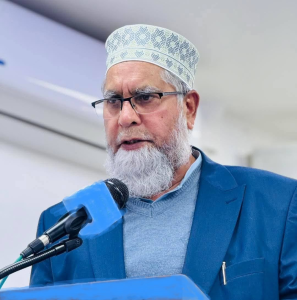
Prof Masood Akhtar Hazarvi
The blessed hours of Ramadan arrive each year to soften hearts, awaken consciences, and remind believers of their true moral identity. This year, as the crescent of Ramadan 1447 AH appeared, its faint light also fell upon the desolate streets of Gaza—upon neighborhoods buried beneath rubble and hopes fading into despair. There, the call to prayer is drowned out by explosions. At suhoor, tables are not spread in homes; instead, long queues form for basic rations. At iftar, while many of us experience spiritual calm alongside our supplications, in Gaza prayers are accompanied by the trembling sound of bombardment. This is not merely a Palestinian tragedy; it is a moral and spiritual trial for all humanity. The essential question is this: in the face of this catastrophe, are we human beings of conscience and faith, or are we silent spectators?
The war that began on 7 October 2023 has pushed the entire society of Gaza to the brink of devastation. Thousands killed, hundreds of thousands injured, families displaced, schools, hospitals, and places of worship destroyed—these are not signs of a temporary military clash but of systematic and prolonged ruin. Announcements of ceasefire have repeatedly sparked hope that bloodshed would end, yet the cycle of bullets and bombs continues unabated. When promises of truce fail to save human lives, they cease to be meaningful words and become instruments of political deception.
Relevant agencies of the United Nations have made it clear that Gaza has entered one of the gravest phases of humanitarian crisis. Food, water, medicine, and shelter—the four basic necessities of human survival—are in acute and persistent shortage. Malnutrition among children, deep psychological trauma, and pervasive fear have cast a shadow of uncertainty over an entire generation’s future. Families crowded into makeshift tents endure an unending ordeal where hunger and thirst are not chosen acts of spiritual discipline, but imposed collective punishment. While we give thanks for our iftar meals, thousands in Gaza long for a single piece of bread. This stark contrast pierces the heart of any sensitive believer. If this awareness fades, fasting risks becoming a mere ritual of hunger and thirst, stripped of its spiritual essence.
Humanitarian aid itself has been obstructed by blockade, political barriers, and security restrictions. Médecins Sans Frontières and other international relief organizations have repeatedly stated that restricted access, closed crossings, and severe security risks have rendered medical services nearly impossible. When ambulances cannot reach the wounded, when doctors’ movements depend on permits and checkpoints, the issue transcends warfare; it becomes an open collapse of humanitarian principles and the global conscience.
The UN Special Rapporteur Francesca Albanese, in a detailed report, described the situation in Gaza as presenting a serious risk of genocide, emphasizing that the international community cannot remain passive. In January 2024, the International Court of Justice issued provisional measures instructing Israel to prevent acts of genocide, ensure humanitarian protection, and facilitate aid access. The pressing question remains: how long will such judicial pronouncements and moral declarations remain confined to paper? When powerful states interpret international law according to political interest, justice itself becomes fragile, ambiguous, and ineffective.
The crisis in Gaza also exposes the double standards embedded within the global political order. In some regions, conflicts prompt immediate resolutions, sweeping sanctions, and intense diplomatic pressure. Yet in the case of Palestine, language is weighed cautiously, and decisions are measured against strategic interests. If human rights are applied selectively—dependent upon geography, ethnicity, religion, or economic calculus—they cease to be principles and become mere slogans. The paralysis of the Security Council and the politics of veto power reveal a system structured less around justice and more around asymmetrical power.
Ramadan teaches us empathy through hunger and thirst, so that we may understand the plight of the hungry, the orphaned, the displaced, and the oppressed. But in Gaza, hunger is not a voluntary spiritual exercise; it is enforced deprivation. This distinction alone should awaken us. If fasting does not connect us to the suffering of others and the wounds of the ummah, it risks degenerating into seasonal religiosity devoid of transformative meaning.
In this context, our collective and individual responsibilities are clear. First, moral clarity: to recognize truth, articulate it, name injustice for what it is, and maintain intellectual and emotional solidarity with the oppressed. Second, practical engagement: to channel financial and material assistance through credible institutions, to convey our message to policymakers through civic participation and the ballot, and to participate in lawful protest, advocacy, and principled boycott where appropriate. Third, intellectual formation: to educate the next generation in international law, human rights, colonial history, and collective Muslim consciousness—so that their engagement is grounded in knowledge, organization, and lawful strategy rather than fleeting slogans.
Emotional rhetoric may provide temporary relief, but history is ultimately written through disciplined, principled, and structured struggle.
The tragedy of Gaza reminds us that worldly powers, however formidable, are ultimately transient, while the call for justice endures. Oppression—however organized or militarized—rests upon injustice and falsehood, and therefore carries within it the seeds of eventual collapse. The true question is not what history will decide; it is where we stand within it: among silent observers, or alongside those who uphold justice and humanity.
Ramadan offers us an opportunity to revive conscience, recalibrate priorities, and integrate action with prayer. Prayer is the soul; action is its body. Worship without action loses its capacity to transform societies.
This crisis is not only about displaced families in Gaza; it is also a test of Muslim leadership, the credibility of international institutions, and the moral claims of modern civilization. If powerful states continue to manipulate international law, if Security Council resolutions remain hostage to veto politics, and if the human rights discourse persists in selective application, then the global order will cease to reflect rule of law and instead resemble a ruthless arena of power politics.
For this reason, Gaza demands not merely emotional sympathy but disciplined, legal, and ethical struggle—one that places principle above expediency, humanity above politics, and justice above all compromise. That is the true message of Ramadan, and that is the essential demand of faith.
