
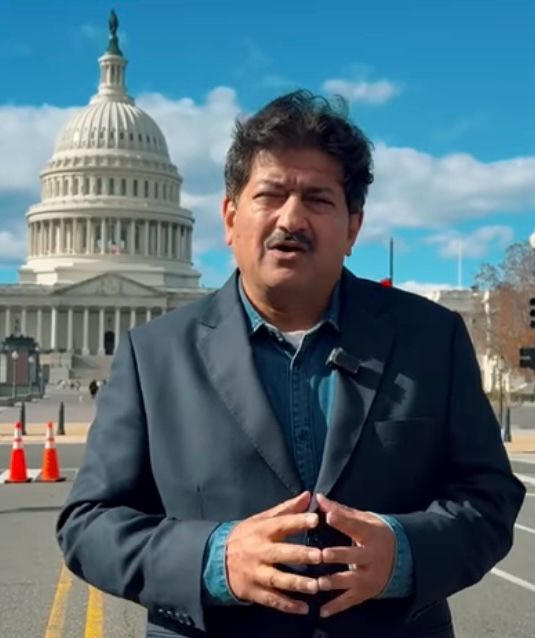
Hamid Mir
Has the parliamentary system failed in Pakistan? Does the solution to Pakistan’s problems lie in the implementation of the presidential system? These questions are not new.
The first Legislative Assembly of Pakistan had approved the 1956 Constitution, under which Pakistan was to be governed by a federal parliamentary system of government. Two and a half years later, in October 1958, Governor General Iskander Mirza, together with Army Chief General Ayub Khan, imposed the first martial law in the country and this parliamentary constitution was abrogated. Most political parties demanded the restoration of the 1956 Constitution, but General Ayub Khan removed Iskander Mirza and seized complete power and imposed a presidential system on Pakistan in 1962. In January 1965, General Ayub Khan held presidential elections in which the mother of the Nation, Mohtarma Fatima Jinnah, emerged as the joint candidate of the opposition. Fatima Jinnah supported the parliamentary system, so Field Marshal Ayub Khan declared her an Indian agent. The important thing was that Sheikh Mujibur Rahman and Khwaja Nazimuddin in East Pakistan, Ghaus Bakhsh Bizenjo, Khair Bakhsh Marri and Attaullah Mengal in Balochistan, Wali Khan in Khyber Pakhtunkhwa and Nawabzada Nasrullah Khan in Punjab to Maulana Maududi, many important political figures were supporting the mother of the Nation.
Unfortunately, the mother of the Nation was defeated through rigging. General Ayub Khan’s presidential system won. The parliamentary system of the mother of the Nation lost. In 1969, the Army Chief General Yahya Khan, who was brought in by himself, removed Field Marshal Ayub Khan and seized power himself. In the 1970 elections, the Awami League won a majority in East Pakistan. Instead of transferring power to the majority party, General Yahya Khan launched a military operation against the Awami League. The military operation gave rise to a civil war. The civil war resulted in the Indo-Pakistan war and unfortunately, Pakistan broke up. In Naya Pakistan, Zulfikar Ali Bhutto became the Prime Minister. He, together with the opposition, drafted the 1973 constitution. Once again, Pakistan was entrusted with a federal parliamentary system of government. The PPP was in power in the centre, Punjab, and Sindh. Balochistan and Khyber Pakhtunkhwa were ruled by a coalition government of the NAP and the Jamiat Ulema-e-Islam. These two coalition provincial governments were not allowed to function for even a year. The NAP was banned and the opposition leadership was sent to jail. The parliamentary system stipulated in the constitution was not implemented honestly. The result was the martial law of 1977. General Zia-ul-Haq ruled Pakistan for eleven years through a presidential system, because all the powers were vested in a president who wore a military uniform. The president held non-partisan elections in 1985 in which Nawaz Sharif became the Chief Minister of Punjab and rose to prominence on the Pakistani political scene.
The 1985 non-partisan assembly introduced a system in Pakistan through the Eighth Amendment in which the president had more powers than the prime minister. President Zia-ul-Haq dismissed his own Prime Minister Muhammad Khan Junejo in 1988. After his death in a plane crash on August 17, 1988, elections were held and Benazir Bhutto became the prime minister. After just 20 months, President Ghulam Ishaq Khan dismissed her. In 1990, Nawaz Sharif became the prime minister. Two years later, President Ishaq dismissed him too. Each time, allegations of corruption and bad governance were leveled. In 1993, Benazir Bhutto became the prime minister for the second time. In 1996, her own party president Farooq Leghari dismissed her. In 1997, Nawaz Sharif became the prime minister again. He first attacked the Supreme Court and then dismissed the army chief he had appointed. Therefore, in 1999, he became the target of a military coup led by General Pervez Musharraf. General Musharraf held an election in 2002 but kept the power to himself. For nine years, he was the black and white master of Pakistan. His power ended in 2008. Asif Ali Zardari became the President and Yousaf Raza Gilani the Prime Minister. Zardari wanted to return the powers of the President to the Prime Minister. Nawaz Sharif strongly discouraged him from keeping the powers because Nawaz Sharif also wanted to become an empowered President in the future. I was one of those people who used to remind President Zardari of the Charter of Democracy in every meeting during that time. This was a promise made by Benazir Bhutto and Nawaz Sharif to the nation, which fools like us were more interested in fulfilling than Nawaz Sharif. Finally, through the 18th Amendment, President Zardari transferred his powers to the Prime Minister. We thought that a golden era would now begin in Pakistan, but this golden era is still a dream.
One day in 2011, ISI chief Ahmed Shuja Pasha called me and said that Pakistan and the current system cannot coexist. I asked which system? He said the parliamentary system. When I strongly disagreed with him, he asked, “Do you want your children to be slaves of Bilawal, Maryam Nawaz, and Moonis Elahi in the future?” Our meeting was quite bitter. Earlier, the prime minister was dismissed by the president. Unfortunately, even after the president’s powers ended, the prime minister was not safe. In 2012, Prime Minister Yousaf Raza Gilani was disqualified by the Supreme Court. In 2013, Nawaz Sharif became the prime minister. In 2017, the Supreme Court also disqualified him.
This was the time when Army Chief General Qamar Javed Bajwa started calling the 18th Amendment more dangerous than Sheikh Mujibur Rahman’s six points. After Nawaz Sharif, Shahid Khaqan Abbasi and then Imran Khan became the prime minister. Imran Khan did not run the government through parliament, but through ISI chief General Faiz Hameed. His government also could not complete its term. Then, after the no-confidence motion, Shahbaz Sharif came. Now, even his opponents call the parliament a mere rubber stamp. After the 18th Amendment, this parliament sometimes made a mockery of parliamentary democracy by giving an extension to General Bajwa and sometimes by-passing infamous laws like the PECA Act 2025. Believe it or not. The fact is that the presidential system brought by military dictators has failed repeatedly in Pakistan, and despite the 18th Amendment, today’s political elite has made a mockery of the parliamentary system as well. From Sindh to Balochistan, the fruits of the 18th Amendment are nowhere to be seen. The repeated postponement of local body elections in Punjab and Islamabad is a failure of both the 18th Amendment and the parliamentary system. Not everything is bad in Pakistan. There is also some good. The good thing is that we still have the broken constitution of 1973, which was broken three times but restored three times.
This is the only agreed document with this nation. If this constitution is implemented properly, all our problems can be solved. Today’s Pakistan cannot afford a new constitution or a new system. Whatever needs to be done, it is better to do it within this constitution. God forbid, if this constitution does not remain intact, then forget about agreeing on a new constitution. The most important question is, has there been any stability in Pakistan after the 26th and 27th amendments? The situation in the first two provinces was bad, and after these two amendments, bodies are also falling in Azad Kashmir. Pakistan does not need more amendments, but a Grand National Dialogue. For the success of this dialogue, it is necessary to strengthen the parliament and protect freedom of expression. This is an important requirement of the constitution. Pakistan will not run with sticks and guns, but only with democracy.
