Wajahat Ali Khan
The Mecca Defence Alliance is a defence pact between Pakistan, Saudi Arabia, and Turkey signed into force on 7 August 2026. It builds upon the earlier Strategic Mutual Defence Agreement signed between Pakistan and Saudi Arabia on 17 September 2025 to include Turkey. The pact’s ratification was officially announced amidst the 2026 Iran war.
The newly formed Mecca Defence Alliance, bringing together Saudi Arabia, Pakistan and Turkey, is the product of years of growing military cooperation and a rapidly changing security environment in the Middle East.
The three countries signed the Mecca Joint Defence Agreement in Mecca on August 7, 2026. Under the pact, an armed attack against any one of the three members is to be regarded as an attack against all three. The governments have described the arrangement as defensive and have stressed that it is not directed against any country.
Roots in Saudi-Pakistan military ties
The alliance did not emerge suddenly. Saudi Arabia and Pakistan have maintained close defence relations for decades, with Pakistan providing military training, technical assistance and personnel support to Saudi Arabia. The relationship was upgraded in September 2025, when Riyadh and Islamabad signed a Strategic Mutual Defence Agreement. That bilateral arrangement provided the foundation on which the broader three-country pact was later built.
At the same time, Pakistan and Turkey had been expanding military cooperation, while Saudi Arabia and Turkey developed stronger defence industrial links, including cooperation involving Turkish defence technology. These overlapping relationships created a foundation for trilateral security cooperation.
Why was the alliance formed?
The immediate background is the worsening security situation across the Middle East. The 2026 conflict involving Iran, Israel and the United States, along with missile attacks and threats to Gulf security, has encouraged regional powers to reconsider their defence arrangements.
For Saudi Arabia, the agreement offers another layer of strategic security. Pakistan brings extensive military experience and a long-standing relationship with the Saudi armed forces, while Turkey contributes a large conventional military and an increasingly important defence industry.
The big question is that, Is it a ‘Muslim NATO’?
The agreement has frequently been compared with NATO because of its collective defence principle. However, analysts caution against treating it as a fully developed NATO-style military organisation.
Pakistan’s Foreign Minister Ishaq Dar has described the pact as purely defensive, while the agreement remains open to possible participation by other countries that accept its principles.
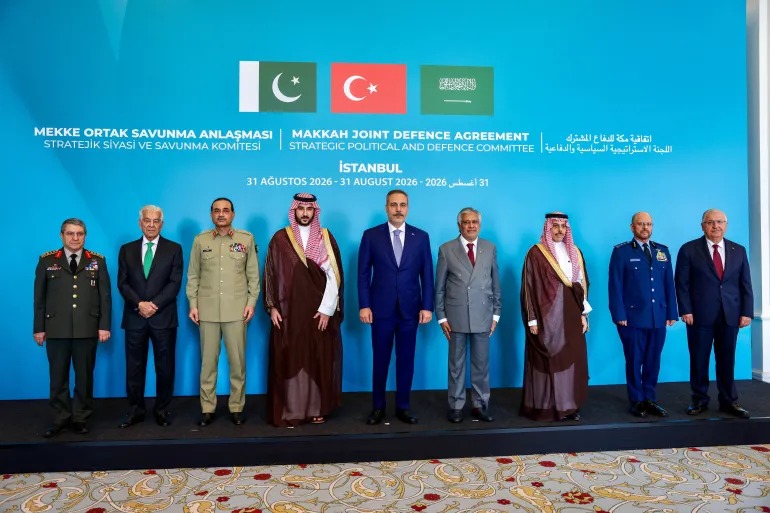
Alliance begins taking institutional shape. The pact moved a step closer to becoming a permanent organisation on August 31, when senior officials from the three countries held the first meeting of its Strategic Political and Defence Committee in Istanbul.
The countries also agreed to establish a permanent secretariat in Riyadh. Turkey’s Foreign Minister Hakan Fidan said the first secretary-general would come from Pakistan and serve an initial three-year term.
What lies ahead?
The alliance’s real significance will depend on whether its political declaration can be converted into practical military cooperation. Questions remain over command arrangements, the response to an attack and the extent of each country’s military commitment.
For now, the Mecca Defence Alliance represents an important new alignment between three influential Muslim-majority states. Its creation signals that Saudi Arabia, Pakistan and Turkey intend to play a more coordinated role in shaping the region’s security at a time of profound geopolitical uncertainty.
50