
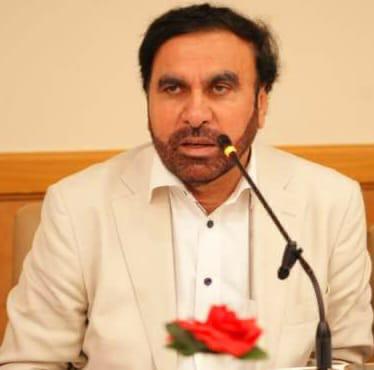
Abdul Razzaq Sajid
Ever since I made serving humanity a permanent purpose of my life, the columnist within me has gradually fallen silent. I still had the pen, and words continued to knock on the doors of my heart. There was never a shortage of subjects to write about, yet I deliberately stopped myself from writing.
Perhaps it was because when one begins to witness human suffering from close quarters, one realises that not everyone understands the language of pain. Some eyes can see tears but cannot read the story behind them. Some ears can hear sobs but cannot reach the cry hidden within them.
I often think that for those sitting in the corridors of power, ears are more important than eyes. The tragedy, however, is that those ears often hear only voices carrying the echo of power, the whisper of vested interests or the footsteps of authority. The cry rising from the chest of a helpless person frequently strikes those high walls and returns to be buried once again in the same heart from which it emerged.
Perhaps that is why I had distanced myself from the pen. But today, the pen is once again in my hand because Kashmir is calling me.
When I look towards Rawalakot, a pain rises within me that I can no longer bury in silence.
Until recently, whenever we heard the word Kashmir, our thoughts immediately turned towards the wounds of Indian-administered Kashmir: the eyes of mothers, the frightened faces of children, the sacrifices of young people and the suffering that has stretched across decades. All of this has become part of our national consciousness.
But today, we are confronted with a different—and perhaps more complicated—question: Why are the people of Azad Kashmir themselves distressed?
These are the very people who have stood with Pakistan’s green-and-white crescent-and-star flag pressed to their hearts, and who have repeatedly raised their voices in support of Pakistan during its most difficult moments. Why, then, are they themselves crying out today?
This is not merely a political question. It is a question for our national conscience.
The people sitting in Rawalakot are not strangers. They are our own. Among them are our brothers, our sisters, our children and our mothers.
The weariness in their eyes asks us a question. The uncertainty in their voices calls out to our collective responsibility.
Their grievances are not merely a list of demands. They are a reminder of the relationship between the state and its citizens—a relationship that ultimately rests on trust.
The cold of Rawalakot is not ordinary cold. When winter changes its course there, the winds acquire an icy bite. Nights become longer, mountains are covered in white sheets and the cold begins to draw warmth from the human body.
If people in such a place are compelled to remain gathered for days in order to have their problems heard, the matter ceases to be merely administrative. It becomes human.
Severe winter is standing at the door. Before snow covers the roads, we should try to melt the ice accumulating between our hearts.
I have always wondered why we forget such a simple truth: no state becomes stronger by pushing its own people away.
States are not sustained by power alone; they are sustained by trust. Nations are not bound together by orders; they are bound together by respect.
If someone in a family becomes upset, you do not throw them out of the house. Someone senior goes to them, places a hand on their shoulder and asks: Tell me, what is troubling you? Where did we go wrong? What hurt your heart?
Then there is conversation. There are arguments. There are disagreements. Sometimes one side takes a step back; sometimes the other does. And that is how the family survives.
A country, after all, is also a large family.
If the state is compared to a mother, then a mother’s first quality is not authority but compassion. A mother does not threaten an angry child. She brings the child closer, listens to them and, at times, even acknowledges her own mistake to ease the burden on the child’s heart.
We must abandon the assumption that the voice of someone with less power is therefore less important.
History is littered with the ruins created by this misconception.
Suppressed hearts do not remain silent forever. When deprivation continues to accumulate, it eventually finds a voice.
Mistaking silence for consent is dangerous. Mistaking fear for loyalty is even more dangerous.
Loyalty is born of love, nurtured by justice and sustained by respect.
That is why I want to appeal, with sincerity and concern, to those in authority: do not look at Rawalakot and the issues of Azad Kashmir through the lens of stubbornness, ego or power.
Bring all relevant parties to one table. Include local religious scholars, spiritual leaders, community elders, civil society, representative organisations and respected individuals who enjoy the confidence of both sides.
Issuing an order is easy. Winning hearts is difficult.
And the true success of a state lies not in making people obey, but in winning their hearts.
On behalf of Al Mustafa Welfare Trust, I have previously offered that, if those in authority deem it appropriate, we can play a role in bringing together our network and respected personalities connected with Kashmir so that a channel for dialogue can be opened, bitterness reduced and progress made towards a practical solution.
Today, I repeat that offer.
I wish to travel to Azad Kashmir accompanied by Muslim members of the British Parliament and some prominent members of the House of Lords, meet the people, listen to them and, if possible, contribute to building a bridge of dialogue capable of reducing the distance between the two sides.
Our objective is not to become part of any political alignment. It is to seek a path towards goodwill and reconciliation in an issue that concerns our own people.
Our relationship with Kashmir is not merely emotional; it is practical as well.
Al Mustafa’s welfare network has been working in different parts of Kashmir for many years. Our Al Mustafa Eye Hospital in Daryal is nearing completion.
The current circumstances, particularly disruptions to internet and communications, create difficulties for such projects because welfare work depends on communication, planning, access to patients and coordination among local teams.
We also organise free medical camps across Kashmir, bringing healthcare to people in remote areas who, under normal circumstances, cannot reach hospitals.
When communication is disrupted, the path of humanitarian service becomes difficult as well.
In Bagh, Al Mustafa has completed a major water project. Water was brought from approximately 15 to 16 kilometres away and supplied to thousands of families.
Local residents told us stories of circumstances that still weigh heavily on the heart when remembered.
In some places, there was a severe shortage of clean drinking water. Water was not available even for ablution, and according to local residents, there were occasions when arranging water to wash the dead before burial was also difficult.
When water finally reached those settlements, the gratitude in people’s eyes was something that no report, statistic or government document could ever fully capture.
That is why Kashmir is not merely a line drawn on a map for us, nor simply a political headline appearing in the news.
People live there.
We have visited their homes. We have seen their children. We have treated their sick. We have brought water to their communities.
Their pain and their prayers are both a trust placed in our hands.
I also want to address all my friends who are committed to service, goodwill and love for their homeland.
Pakistan is not merely the name of a geographical territory. It is also the name of the relationships that exist between hearts.
Countries are not made complete simply by drawing borders on maps. They become complete when trust is created in the hearts of their people.
It is not enough to tell our Kashmiri brothers and sisters that we are listening to them. We must actually listen to them.
Not every demand necessarily has to be right. Nor is every government position necessarily wrong. But closing the door to dialogue is perhaps the greatest mistake of all.
The answer to disagreement is dialogue.
The answer to a grievance is listening.
The answer to anger is patience.
And the answer to distance is love.
For a long time, I kept the columnist within me silent. Perhaps I feared that I did not know whose temperament our cry might offend, whose comfort our pain might disturb, or whose forehead might crease with concern because of our restlessness.
But sometimes silence itself becomes a question.
And there are some silences whose weight the pen can no longer bear.
The present unrest in Azad Kashmir has awakened my pen once again.
The voice rising from the cold atmosphere of Rawalakot is telling me that there is still time.
There is still time to prevent grievances from turning into hatred. There is still time to speak a few words of love before resentment turns into alienation.
For God’s sake, do it today. Do not leave it for tomorrow.
Cold does not descend only upon the weather. Sometimes it settles upon relationships as well.
And once ice forms over relationships, it takes a very long time to melt.
Go to your people. Listen to them. Let them hear your side as well.
If we have made a mistake somewhere, admitting it is not defeat.
And if there is a misunderstanding on their part, remove it with love.
This is civilisation. This is politics. And this is the wisdom of governance.
Remember:
Nations are built not by power, but by trust.
States are strengthened not by fear, but by justice.
And a homeland is not merely a piece of land; it is also the hearts of those who feel connected to it.
When hearts are broken, even secure borders become sorrowful.
And when hearts remain connected, even the harshest seasons eventually pass.
Rawalakot is calling us today.
This is not the call of an enemy.
It is a voice rising from our own home.
For God’s sake, listen to it.
