
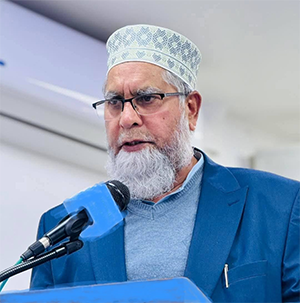
Prof Masood Akhtar Hazarvi
Political disagreement, criticism and satire are integral to democratic societies. Leaders must be questioned, policies challenged, and decisions openly debated. However, freedom of expression also demands wisdom, sensitivity and responsibility, particularly when religious beliefs and sacred personalities are involved. Recent remarks attributed to US President Donald Trump have raised an important question: do world leaders fully appreciate the impact of their words on the religious sentiments of millions?
According to a Reuters report, on 16 October 2026, during an election rally in Dalton, Georgia, President Trump was discussing Iran when he reportedly remarked that if someone could not remember a Middle Eastern person’s name, they could simply call them “Muhammad”, adding that there was a 65 per cent chance of getting it right. He subsequently imitated addressing several people by that name. The audience reportedly showed little reaction.
It is important to distinguish between the reported words and their interpretation. The remarks, as reported, did not explicitly insult the Holy Prophet Muhammad (peace and blessings be upon him). The joke apparently concerned the popularity of the name. Nevertheless, the question remains: can a name carrying profound religious significance be treated as an ordinary subject of political humour without considering its wider implications?
For Muslims worldwide, the name Muhammad represents far more than a collection of letters. It embodies love, devotion, spiritual identity and an enduring connection with the final Messenger of Allah. When Muslim parents name their children Muhammad, they express their attachment to the Prophet’s exemplary life and teachings. From homes and mosques to religious gatherings and everyday conversations, this blessed name is spoken with deep affection and reverence.
The Holy Qur’an declares, “And We have raised high your mention” (94:4). This divine affirmation of the Prophet’s exalted status explains why reverence for him occupies such a central place in Muslim faith. Surah Al-Hujurat also instructs believers to observe proper respect when addressing the Prophet (49:2). Such teachings demonstrate that respect is not a superficial formality; it is an essential expression of faith and moral character.
President Trump, like any political leader, has the right to criticise governments, question policies and engage in robust political debate. Such criticism is a legitimate feature of democratic life. However, political disagreement should not become an excuse for language that risks trivialising what millions hold sacred. The distinction between criticising political positions and making religiously significant names objects of ridicule deserves serious consideration.
The name Muhammad transcends national, geographical and cultural boundaries. From Arabia to Africa, Asia, Europe and America, Muslims name their children after the Prophet because of their profound spiritual attachment to him. Millions of people bearing this name live in the United States and other Western countries. Consequently, sensitivity towards it is not merely a matter of international diplomacy; it is also a question of respecting fellow citizens and the diversity of modern societies.
We should not presume to know President Trump’s intentions. He may have regarded his remarks as harmless humour. Yet intentions alone do not determine the impact of words. When public statements cause widespread distress, responsible leadership requires reflection, clarification and, where appropriate, an apology. Freedom of expression protects the right to speak, but it does not eliminate the moral responsibility to consider the consequences.
The influence of the American presidency extends far beyond domestic politics. Statements made at election rallies can travel across the world within minutes, shaping public perceptions and influencing relations between communities. Careless language concerning religious sensitivities can deepen mistrust at a time when the international community urgently needs dialogue, cooperation and mutual understanding.
Importantly, Islam itself teaches respect for the religious sensitivities of others. The Qur’an states, “And do not insult those whom they invoke besides Allah” (6:108). This instruction establishes a powerful principle: religious provocation should be avoided because it can generate hostility and lead to further disrespect. Muslims must uphold this principle through their own conduct while expecting comparable consideration from others.
There can be no compromise on the dignity and reverence Muslims associate with the blessed name of their Prophet. Nevertheless, any response must remain peaceful, dignified and lawful, reflecting the patience, justice and excellent character exemplified by the Prophet himself. International institutions, including the United Nations, should continue promoting religious freedom, human dignity and responsible public discourse while recognising the importance of freedom of expression.
The appropriate course is straightforward: President Trump should clarify the intention behind his remarks. If his words have caused distress among Muslims, a sincere and unequivocal apology would demonstrate respect and responsible leadership. Apologising does not diminish a leader’s stature; rather, it demonstrates humility, maturity and the courage to acknowledge the consequences of one’s words.
In a world already burdened by conflict, political tensions and religious prejudice, public figures should build bridges rather than deepen divisions. Peace depends not only on treaties and diplomatic agreements but also on the language leaders use and the respect they demonstrate towards others.
Ultimately, a Muslim’s love for the Messenger of Allah (peace and blessings be upon him) cannot be diminished by mockery or suppressed by pressure. Yet that love must also inspire a response characterised by wisdom, dignity and compassion. Respect is not weakness, and an apology is not humiliation. Both are signs of civilisation.
This is a lesson every world leader, from Washington to the United Nations, should understand: true greatness lies not merely in the power to speak, but in the wisdom to recognise the responsibility that words carry.
