
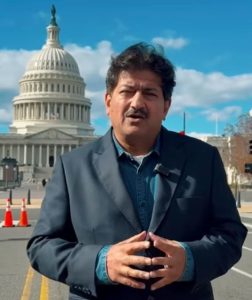
Hamid Mir
Spring brings with it the Faiz Mela, in which Faiz Ahmed Faiz’s admirers, poets, writers, artists, students, lawyers, workers and political activists remember Faiz Sahib in their own way. This year’s Faiz Mela at Alhamra Hall, Lahore took me back to the era of oppression when I first saw Faiz’s deewans dance. In February 1986, the first Faiz Mela was also held in the same Alhamra Hall, Lahore. At that time, I was a student at Government College Lahore (now Government College University). This was the first literary and cultural festival organised in Faiz Sahib’s memory after his death in 1984. Four decades have passed in the blink of an eye. It seems like yesterday that when Iqbal Bano started singing Faiz Sahib’s poem “Hum Dekhenge” at Alhamra Hall, the entire hall started swaying. Many poets and writers including Zaheer Kashmiri, Manubhai and Javed Shaheen started dancing in front of the stage and when Iqbal Bano said that “All thrones will be overthrown”, the entire hall echoed with slogans against the then military dictator General Zia-ul-Haq. Even today, when I hear this poem by Faiz Sahib in the voice of Iqbal Bano, I am transported to February 1986. This time, after listening to the words of many of his fans at the Faiz Mela, I felt that we have not moved beyond 1986. I was wondering what kind of poems Faiz Sahib would have written about this era if he were alive today? This question was also hammering my mind that if Faiz Sahib were alive, would he have been in a jail or exiled? I was also remembering the second Faiz Mela which was held in 1987 at the open-air theatre in Bagh Jinnah. During the Mushaira, when Ahmed Nadeem Qasmi Sahib was invited to recite the Kalam, many youths started shouting slogans against him, which made Faiz Sahib’s wife Alice Faiz very angry. Later it was found out that once there was a disagreement between Ahmed Nadeem Qasmi and Faiz Sahib over Allama Iqbal. Ahmed Nadeem Qasmi wanted to use the Progressive Writers Association against Allama Iqbal. Faiz Sahib was not in favour of this, he defended Allama Iqbal strongly and separated from the Association. Due to this old disagreement, some elders incited the youth to shout slogans against Ahmed Nadeem Qasmi. These elders were angry that why did Qasmi Sahib receive the Sitara-e-Imtiaz from General Zia? Alice Faiz scolded those who shouted slogans against Qasmi Sahib and said that Faiz Sahib never misbehaved with his opponents and critics and respected Qasmi Sahib very much. I was wondering if Faiz Sahib were alive today, how would he have reacted to the recent election results in Bangladesh? I was reminded of his poem ‘On Returning from Dhaka’. He had written this poem on a plane while returning from Dhaka in 1974. He was part of the official delegation that went to Bangladesh with Prime Minister Zulfikar Ali Bhutto. He was highly respected in Bangladesh because he had opposed the military operation of 1971 that resulted in the creation of Bangladesh. Faiz Sahib had said about this operation:
سجے تو کیسے سجے قتل عام کا میلہ
کسے لبھائے گا، میرے لہو کا واویلہ
Zulfikar Ali Bhutto wanted Faiz Ahmed Faiz to become Pakistan’s ambassador to Bangladesh and bring the two countries closer. Faiz Sahib was ready for this work, but due to misunderstandings between Bhutto and Sheikh Mujibur Rahman, this move could not proceed. While returning from Dhaka, the then Minister of Culture Malik Muhammad Jafar asked Faiz Sahib to express his impressions in poetry. Faiz Sahib had recited this poem while sitting in the plane.
ہم کہ ٹھہرے اجنبی اتنی مداراتوں کے بعد
پھر بنیں گے آشنا کتنی ملاقاتوں کے بعد
کب نظر میں آئے گی بے داغ سبزے کی بہار
خون کے دھبے دھلیں گے کتنی برساتوں کے بعد
During the Faiz Mela of 2026, I kept thinking that perhaps after so many rains, many blood stains that had stained our skirts were washed away. If Faiz Sahib were alive today, he would not have remained silent about the many fresh blood stains and would have been declared a traitor again. I was remembering March 2013 when I decided to go to Dhaka with some other Pakistanis including Asma Jahangir, Salima Hashmi, Hasil Bizenjo and Tahira Habib Jalib where I received the Friends of Bangladesh Award for my father Waris Mir, Asma Jahangir for her father Malik Ghulam Jilani, Salima Hashmi for her father Faiz Ahmed Faiz, Hasil Bizenjo for her father Ghaus Bakhsh Bizenjo and Tahira for her father Habib Jalib and we were all declared traitors. On our return from Dhaka, we thought that Hasina Wajid was trying to wash away the blood stains through these awards but after some time her government, under Indian pressure, stopped the Bangladesh cricket team from touring Pakistan. In response, the Pakistani team’s tour of Bangladesh was also cancelled, against which I strongly protested to the Bangladeshi government. At the Faiz Mela, I kept thinking that the way Pakistan supported Bangladesh against India in the T20 World Cup this year and forced the ICC to address the injustice done to Bangladesh, washed away some of the blood stains shed in 1971. If Faiz Sahib were alive, he would have been very happy because he himself was a cricket fan. Once, in an interview, he had told Ahmed Faraz and Iftikhar Arif that he had a great desire to become a cricketer in his childhood, but it is a pity that he could not become a cricketer. Faiz Sahib was a multifaceted person. He was also a poet, a journalist and he had also written the story of a film called ‘Jago Hua Sawira’. This was the first Urdu film to be made in East Pakistan, i.e. Bangladesh, and all the shooting took place in a fishing village on the banks of the Meghna River. This film was completed in 1958. As soon as the film was completed, General Ayub Khan’s martial law was imposed in Pakistan and Faiz Sahib was arrested. This film was banned in Pakistan even though it could have brought East Pakistan and West Pakistan closer. This film won awards at many international film festivals including Moscow, but Faiz Sahib was repeatedly arrested and declared an enemy of the country and a traitor. It was those who declared him a traitor who broke this country. Faiz Sahib also saw solitary confinement and was even taken around the markets in handcuffs. Even today, no one understands that accusations of treason, solitary confinement and handcuffs do not make states stronger or weaker. Faiz’s words still sound fresh today because the situation in this country has not changed. That is why even today, when the talk of overthrowing the throne and throwing away the crown is mentioned in the Faiz Mela, the same passion is seen in the youth that I saw in the first Faiz Mela in 1986.
