Amr Roshdy
Egypt
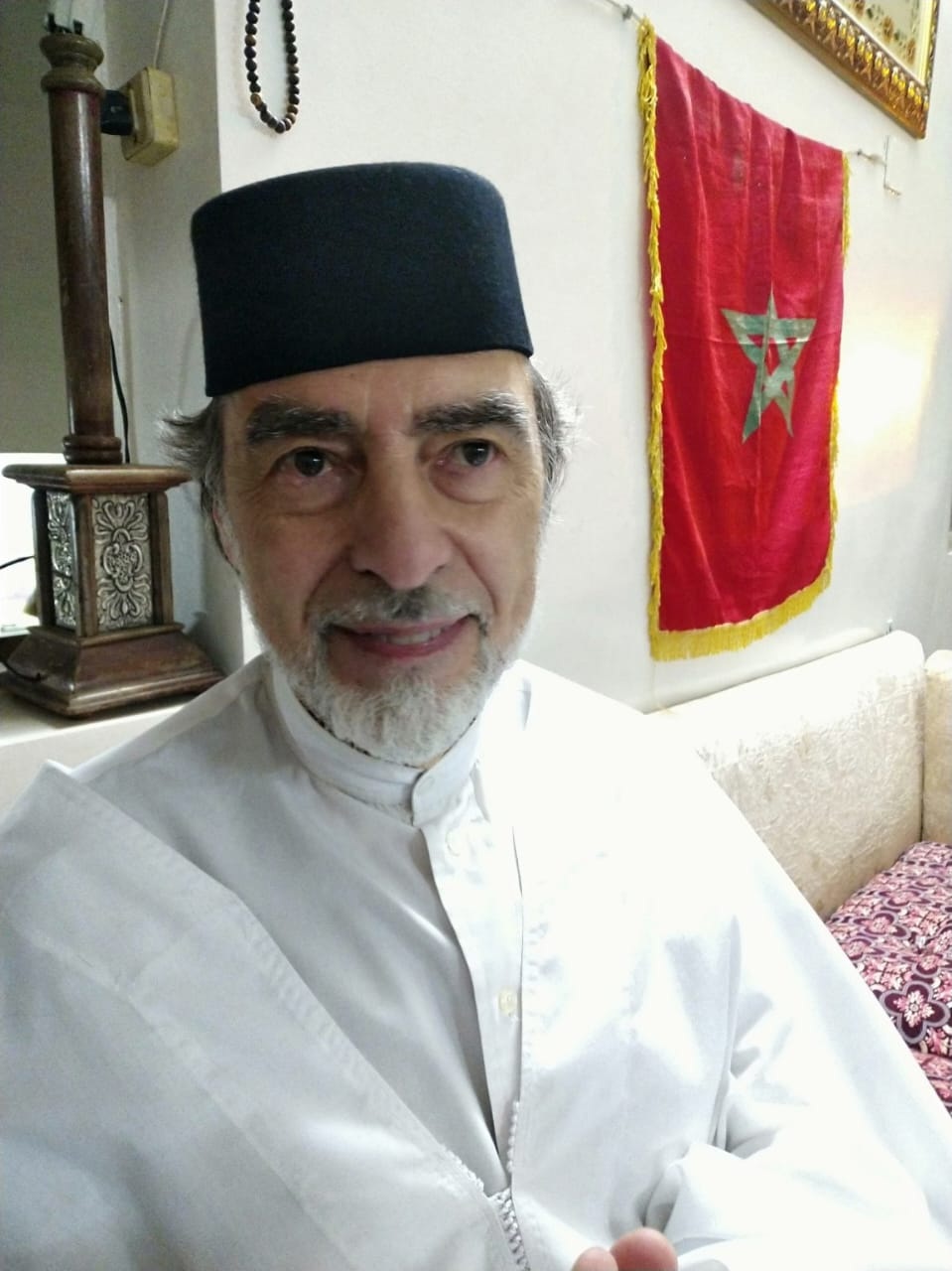
In depth and detailed interview of Sheikh Abdul Samad Al-Tijani the Sheikh of the Tijaniyya Order and Sufi leader in Italy, reflects on his spiritual journey and his initiation into Sufism, explaining how his spiritual quest led him to the Tijaniyya path, which has become an essential part of his life and work.
The Sheikh also discusses the role of Sufism in the modern era, particularly within the European and Italian context. He provides insight into the challenges faced by Sufi orders in the West, as well as the relationship between Sufism and values of tolerance and coexistence among religions. Additionally, he clarifies the role of dhikr (remembrance of God) and awrād (daily spiritual practices) in the disciple’s life, and explains how Sufism integrates both the spiritual and intellectual aspects of life in the Western world.
How did your journey into Sufism begin, and what specifically led you to the Tarīqa Tijāniyya?
In brief, my beginnings with Sufism were the fruit of a sincere spiritual yearning for truth and knowledge. This yearning first led me to the writings of René Guénon, and then to the legacy of the Great Master Muhyī al-Dīn Ibn ‘Arabī, may God be pleased with him. My encounter with his book Fusūs al-Hikam was a pivotal moment, for it opened my inner sight to the Mashrab al-Muhammadī (the spiritual source of Muhammadan tradition) in its purest form.
After that, I traveled to Cairo to study the Arabic language and to seek a complete and realized Shaykh who could guide me on the path. Everything that followed was by God’s grace and guidance, for He led me directly to Shaykh Muhammad al-Hāfiz al-Tijānī, may God be pleased with him. Meeting him was one of the greatest blessings and clearest signs in my life.
How would you describe your current role as Shaykh of the Tijāniyya Order in Italy?
In its essence, my role does not differ from that of any other muqaddam of this Tarīqa: it is a function of service — service to the Shaykh, to the Tarīqa, and to the ahbāb, the name given to the Tijānī disciples entrusted to my care. This service also entails an intellectual clarification of the haqāʾiq al tawhīd, al risāla, and al walāya.
Since our return to Italy, after the years spent in Egypt studying Arabic and the Islamic sciences in the 1970s, we have devoted ourselves to publishing translations and studies on Sufism in Italian, and more recently also in French and English. This project will, God willing, continue in the years to come.
How do you view the current state of Islamic Sufism in Europe in general, and in Italy in particular?
René Guénon’s work opened, both in Europe and in Italy, a new intellectual horizon, restoring to contemporary consciousness the possibility of a rigorous approach to the ḥaqāʾiq ʿirfāniyya — the intelligible and gnostic realities — beyond emotional or sentimental expressions, however religious or mystical they may appear. Yet this remains, by its very nature, a circumscribed reality: a niche addressed to those genuinely moved by the search for metaphysical meaning and principial order.
At the same time, other dimensions of Sufism have taken root in recent decades, for Islam has entered the West through various channels: globalisation, migration, and the presence of Turuq of a more popular character. The European landscape — and the Italian one in particular — thus reflects this dual dynamic: on the one hand, a more selective intellectual and initiatic interest; on the other, a broader diffusion linked to communal and devotional forms.
What are the most significant challenges that Sufi orders face in Western societies?
The foremost challenge is to preserve an inner equilibrium and a profound vision of the Supreme Reality (al ḥaqīqa al ʿāliya al kulliyya), so as to remain centred despite the upheavals that mark this age of decisive transformations. It is essential not to be drawn into outward movements, nor to become entangled in the radicalised tendencies of contemporary society — whether Islamic or otherwise.
Truth remains the sole essential criterion. As Guénon wrote at the end of The Crisis of the Modern World, the motto of the Western ʿirfānī Sufis should be: “Vincit omnia veritas” — Truth always prevails.
Is there interest among non Muslims in deepening their knowledge of Sufism and how does this interest manifest?
There is indeed an interest, though it does not concern the Western public at large. It appears rather among those who are moved by an inner need for “spiritual” truth — at times not yet clearly defined. At this point, however, different paths open, depending on the inner dispositions — what Guénon would have called qualifications — of each individual.
Many are drawn by a taste for the exotic, for what appears “Eastern”: the same current that leads Westerners towards the interior forms of Hinduism or Buddhism. Within this tendency we also find those who approach Sufism as one among several Eastern spiritual movements, often motivated by disappointment with what remains of the ancient spiritual world of Christianity.
For those, however, who have studied and assimilated Guénon’s work, the matter presents itself in an entirely different light: more esoteric (in the authentic sense of bāṭinī, not in the sense of the deviant currents within Islam) and more genuinely gnostic, oriented towards the understanding of principial realities and intelligible truths.