
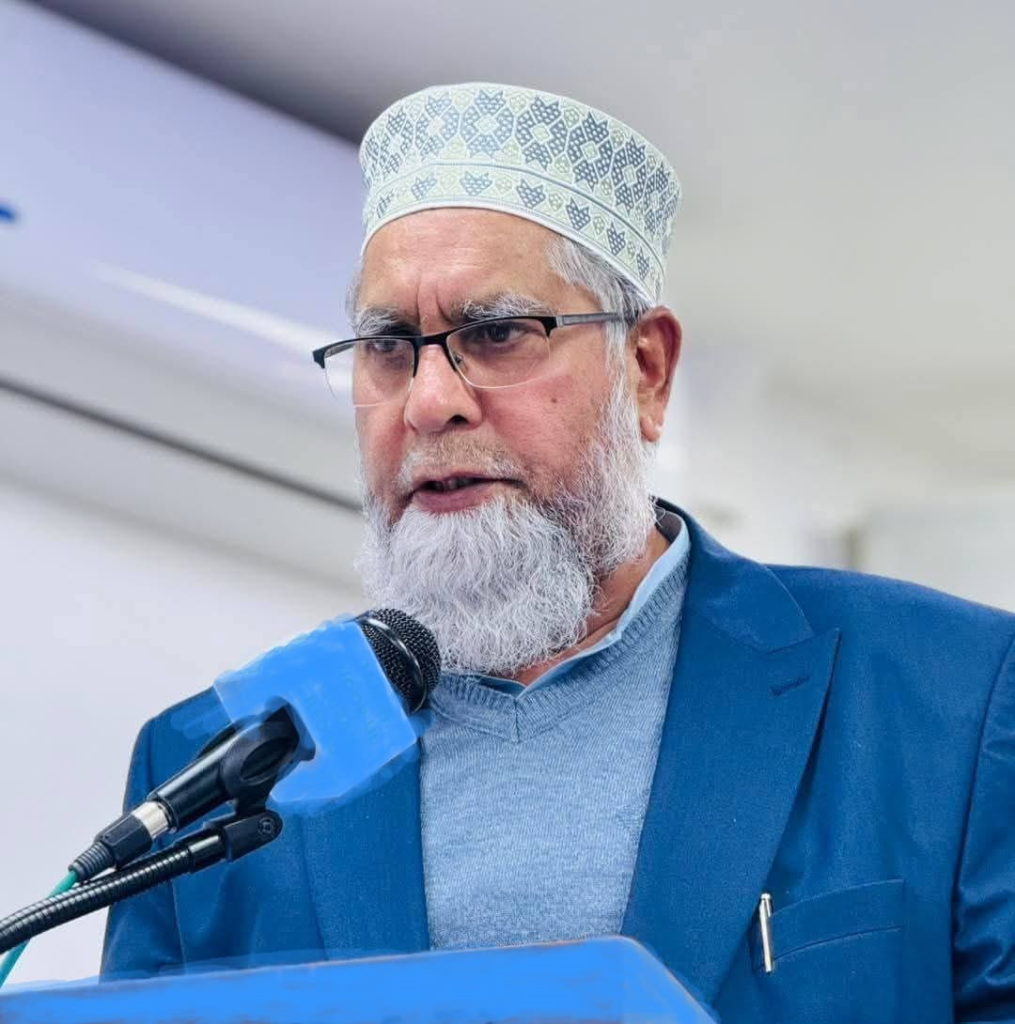
Prof Masood Akhtar Hazarvi
The greatest tragedy of the 21st-century Muslim world is not a shortage of resources, but the persistent failure to make use of God-given blessings. They possess a complete and comprehensive worldview in the form of Islam, a large number of action-driven youth, abundant natural resources, a glorious civilizational heritage, and a comprehensive moral and social system. Yet despite all this, leadership appears hesitant, weak, and lacking the courage to make decisions. The rhetoric has always been loud, but practical steps have always fallen short. This contradiction has been gradually scattering the collective strength of the Muslim community. This is not merely a political crisis — it is a symptom of a comprehensive intellectual and practical decline.
The recent Gaza crisis exposes this weakness with full intensity. Muslim populations expressed pain, grief, and solidarity wholeheartedly. Protests took place around the world, voices rose on social media, and a shared anguish was felt in hearts. But at the state level, the response was fragmented, disorganized, and largely ineffective. Statements contained condemnation, but there was no concrete action to end the oppression. Words of honor were on the tongue, but pragmatism dominated policy. This stark contradiction not only damaged trust internally, but also firmly established on the global stage the impression that the Muslim world is emotional but lacks decisive power.
The Gulf states are rapidly advancing on the path of modernization, investment, and regional stability — a noteworthy development in its own right. However, efforts to normalize relations with Israel raise a fundamental question: can economic interests be prioritized while ignoring the collective pain of the Muslim community? Turkey’s politics suffers from the same internal tension — on one hand, vigorous representation of public sentiment, and on the other, continuity of economic ties with Israel. Thus the struggle to maintain a delicate balance between principle and interest continues, which at times takes the form of clear contradiction.
Saudi Arabia possesses religious centrality, vast financial resources, and regional influence, yet several of its decisions invite serious criticism. The prolonged war in Yemen, its cautious role in global energy politics, and shifting regional priorities all indicate how complex domestic and external pressures have become. Pakistan’s example is even more delicate and instructive. Despite being an ideological state, its practical direction drifted far from its own declared values. The economy ran on borrowed money, the political system remained unstable, and foreign policy was often shaped under external pressure. As a result, a vast and deep gulf emerged between ideology and action, which affected the very identity of the state.
Malaysia and Indonesia chose a comparatively balanced path, where a pleasant harmony is visible between development, institution-building, and religious identity. These countries practically demonstrated that modern governance and religious values are not opposites — they can complement each other. Iran’s revolution was a manifestation of a great ideological awakening, but economic sanctions, global pressure, and internal restrictions limited its momentum. From all these examples, one truth becomes as clear as daylight: ideology alone is not enough. Strong institutions, transparent governance, a balanced economy, and active public participation are indispensable. If ideology does not translate into institutions and a practical system, it remains nothing more than a slogan.
The real crisis of the Muslim world is not external — it is fundamentally internal in nature. Intellectual ambiguity, organizational weakness, and directionless leadership are its prominent features. Using religion in electoral politics and then bowing to expediency after gaining power badly damages public trust. The educational system also absorbed Western concepts without any critical scrutiny, resulting in an intellectual and educational framework that was neither fully Islamic nor purely Western. This intellectual disorder has left the new generation facing an identity crisis and deprived leadership of ideological coherence.
The world today still searches for a balanced system that can unite human dignity, economic justice, and moral values. Capitalism staggers under its own internal contradictions, communism lies buried under the weight of history, and liberal democracy also faces serious questions in many societies. In such circumstances, if Islamic principles are implemented with seriousness, wisdom, and gradual care, they can present a moral, just, and humane alternative. But unfortunately, these possibilities have so far remained confined to speeches and narratives — they could not take the form of a coherent system. The model of the State of Madinah is precisely why it still stands as a living and luminous example, where equality before the law, accountability of the ruler, economic justice, and moral order existed as an integrated system. Real strength lay not merely in resources, but in the harmony of principles and their practical implementation.
Ultimately, the problem is not one of resources but of will. Lasting and meaningful change is only possible when education is purposeful, the economy is built on honesty and transparency, law delivers justice without discrimination, media fulfil its duty of awareness and enlightenment, and leadership is genuinely accountable. Nations rise not on the strength of resources alone, but through firm resolve, clear direction, and collective consciousness. Perhaps the future historian will characterize this era as a time of Muslim inaction and indifference but history’s lesson is this: when nations recognize their weaknesses and resolve to reform, the doors of revival do not remain shut. They open with new strength and new determination.
