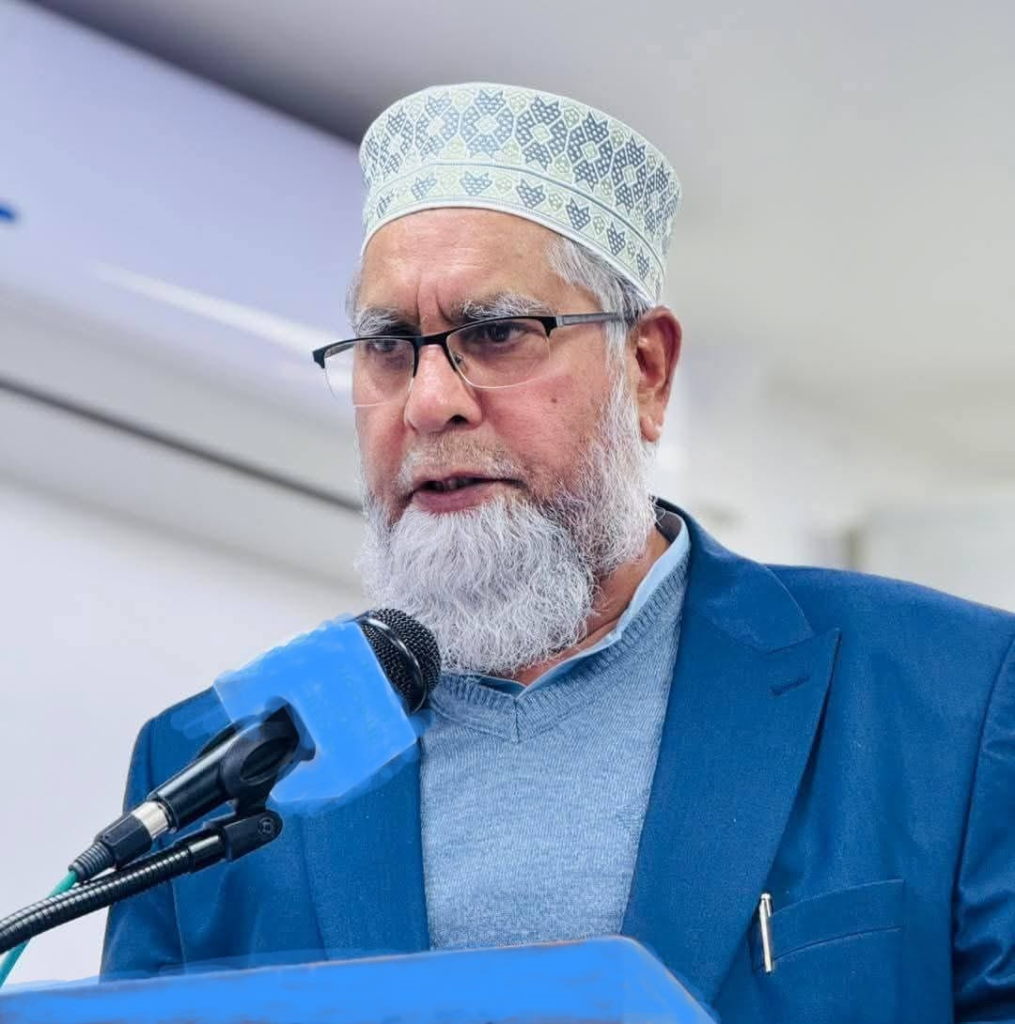
Prof. Masood Akhtar Hazarvi
Imam-e-Aali Maqam, Sayyiduna Imam Husayn (RA), occupies a unique, eternal, and radiant place in Islamic history. The mere mention of his name fills hearts with reverence, brings tears to the eyes, and awakens within souls a renewed commitment to truth and righteousness. His blessed life, unwavering patience, steadfastness, and supreme sacrifice not only awakened the conscience of the Muslim Ummah but also established a permanent standard distinguishing truth from falsehood, a standard that can never be erased.
Imam Husayn (RA) was the beloved grandson of the Prophet Muhammad ﷺ, the son of Sayyiduna Ali al-Murtada (RA), and the cherished son of Sayyidah Fatimah al-Zahra (RA), the leader of the women of Paradise. This noble lineage was not merely an honor of birth but a connection to the pure and divinely chosen household of the Messenger of Allah ﷺ. Love for the Ahl al-Bayt is a sign of faith, and respect for them remains a treasure in the heart of every Muslim.
The Holy Qur’an clearly emphasizes the exalted status of the Prophet’s household. Allah Almighty says:
“Indeed, Allah intends only to remove all impurity from you, O People of the Household, and to purify you completely.” (Al-Ahzab 33:33)
Likewise, Allah says:
“Say: I ask of you no reward for this message except love for my near relatives.” (Ash-Shura 42:23)
The verse of Mubahalah further highlights the distinguished position of the Ahl al-Bayt. When the Christians of Najran were invited to the event of Mubahalah, the Prophet ﷺ brought only Ali, Fatimah, Hasan, and Husayn (RA). This demonstrates the special nearness, purity, and virtue granted to them by Allah.
The sayings of the Prophet ﷺ also speak of Imam Husayn (RA) with immense love and honor. The Messenger of Allah ﷺ said:
“Husayn is from me, and I am from Husayn. May Allah love the one who loves Husayn.”
In another narration, he said:
“Hasan and Husayn are the leaders of the youth of Paradise.”
These statements are not merely expressions of family affection; they are guidance for the entire Ummah, affirming that Imam Husayn (RA) stands as a beacon of truth, morality, sincerity, and faith.
Imam Husayn (RA) embodied worship, piety, generosity, courage, patience, and noble character. His nights were spent in prayer, supplication, and recitation of the Qur’an, while his days were devoted to serving humanity, supporting the oppressed, and promoting justice and righteousness. His life demonstrates that true leadership is founded not upon power, wealth, or military strength, but upon character, integrity, and devotion to God.
With the accession of Yazid to power, circumstances emerged within the Muslim state that posed a profound moral and religious challenge to the Ummah. Yazid’s rule represented more than a political transition; it introduced attitudes and practices that conflicted with Islamic justice, piety, and the values established by the Prophet ﷺ. Imam Husayn (RA) viewed this situation not as a struggle for political authority, but as a matter concerning the preservation of religion, the guidance of the Ummah, and the defense of truth.
He declared:
“I have not risen to spread corruption or seek power; rather, I have risen to reform the Ummah of my grandfather.”
These words constitute the very manifesto of the movement of Imam Husayn (RA).
The people of Kufa sent thousands of letters inviting him and pledging their support. However, when the moment of trial arrived, many succumbed to fear, worldly interests, and oppression. Imam Husayn (RA), accompanied by his family and a small group of loyal companions, reached the plain of Karbala, where they were prevented from proceeding.
Although the River Euphrates flowed nearby, access to water was denied. Children suffered from thirst, women were distressed, and the elderly and the young alike faced severe hardship. Yet Imam Husayn (RA) remained steadfast, with patience upon his face, remembrance of Allah upon his tongue, and complete trust in his heart.
The tenth of Muharram, 61 AH, became one of the most significant days in human history. On one side stood worldly power, armies, and authority; on the other stood the beloved grandson of the Prophet ﷺ, his devoted companions, and the sacred household of the Messenger of Allah.
The loyalty of Hazrat Abbas, the bravery of Ali Akbar, the courage of Qasim, and the innocent thirst of Ali Asghar continue to move hearts across generations. On the banks of the Euphrates, loyalty sacrificed itself, youth gave its life, innocence shed its blood, and finally Imam Husayn (RA) offered his own life without bowing before falsehood.
When Imam Husayn (RA) entered his final prostration on the burning sands of Karbala, history itself turned a new page. His body was wounded, his family members had been martyred, and the tents had become desolate, yet the banner of truth remained raised. At that moment, Husainiyat became more than an event; it became a philosophy.
Husainiyat is not merely the story of a battle; it is the awakening of human conscience. It is not simply a historical event; it is an eternal declaration against oppression. It is not confined to tears and emotions; rather, it represents character, perseverance, sacrifice, and unwavering commitment to principles.
Imam Husayn (RA) taught humanity that if one must sacrifice one’s life for truth, such a sacrifice is not a loss but a victory. He demonstrated that true strength lies not in armies and weapons but in faith, sincerity, and righteousness. Oppression may appear victorious for a time, but it can never prevail forever. Karbala proclaimed to the world that swords may wound bodies, but they cannot kill the truth.
More than fourteen centuries have passed, yet Karbala remains alive. People of different religions, cultures, and nations regard the sacrifice of Imam Husayn (RA) as one of the greatest examples of the struggle for justice and human dignity. Every oppressed person draws courage from Karbala, while every tyrant becomes a symbol of Yazid.
A famous couplet beautifully expresses this reality:
“The martyrdom of Husayn was, in fact, the death of Yazid;
Islam comes alive after every Karbala.”
Today, as the world faces injustice, materialism, moral decline, and growing indifference, the message of Husainiyat is more relevant than ever. It teaches us to stand for truth, speak against oppression, remain steadfast upon principles, and sacrifice for the pleasure of Allah.
The martyrdom of Imam Husayn (RA) reminds us that true honor and dignity lie in remaining firm upon truth, regardless of the sacrifices required. Karbala teaches us that silence can sometimes become support for oppression, while a voice raised for truth continues to inspire generations.
Husainiyat represents justice, truthfulness, loyalty, patience, perseverance, freedom of conscience, moral courage, and submission to the will of Allah. Therefore, Karbala is not merely an event of 61 AH; it is a living message, a guiding light, and an eternal invitation for every generation.
May Allah grant us sincere love for the Ahl al-Bayt, enable us to follow their noble example, adopt their teachings, and uphold truth and justice in every age.
Ameen, O Lord of the Worlds.