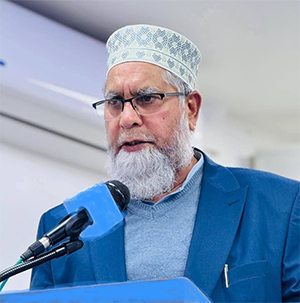
Professor Masood Akhtar Hazarvi
The merchants lived and traded among the local populations. As relationships developed, intermarriages took place, giving rise to families and communities. At the same time, mosques were built to meet the religious needs of the people, and religious schools were established. Thus, the faith that had initially arrived with travelling caravans gradually became part of the lives of local communities. With the passage of time, Islam was no longer regarded as something foreign; it became the faith of ordinary households.
One particularly important fact deserves reflection: the conversion of a ruler to Islam and the conversion of an entire population are not the same thing. A ruler may sometimes embrace a religion for political or strategic reasons, but the hearts of ordinary people do not change overnight. People observe character. They examine relationships. They draw light from centres of knowledge, and gradually, generation after generation, a faith becomes embedded in their lives. The journey of Islam in West Africa was similarly a long and gradual process in which trade, education, religious preaching, spirituality and relationships with local societies all played their respective roles.
The history of ancient Ghana, Takrur, Mali and, later, the Songhai Empire bears witness to the fact that commercial and intellectual links between West Africa and the wider Muslim world were established many centuries ago. Then, in the fourteenth century, the pilgrimage to Makkah undertaken by the great ruler of Mali, Mansa Musa, became a remarkable symbol of this connection. His journey to Makkah gained extraordinary fame throughout the Islamic world and helped place Mali and Timbuktu even more prominently on the intellectual and cultural map of the Muslim world.
The name Timbuktu still reminds us that Africa has not merely been a land of gold, oil and minerals. It has also been a land of knowledge. The Qur’an was studied here. Hadith was taught. Books of Islamic jurisprudence were written. Religious schools flourished. Students travelled from distant regions to study. Scholars educated generations and passed their intellectual heritage from one generation to another.
Wherever Islam reached, it did not merely establish mosques; it also lit the lamps of knowledge. The very first revelation of the Qur’an directs humanity towards knowledge: “Read in the name of your Lord who created.” Perhaps this is why Islam in West Africa did not remain merely a religious identity; it profoundly influenced society, culture and everyday life.
In later centuries, Sufi orders such as the Qadiriyyah and Tijaniyyah deepened this spiritual journey even further. Scholars and Sufis lived among ordinary people and taught them the Qur’an and Sunnah. Gatherings of remembrance of Allah were held. Love for Allah was cultivated in hearts. The lamps of love for the Messenger of Allah ﷺ were illuminated. Religion was no longer confined to books; it gradually became woven into the lives of the people.
Islam reached the homes of farmers. It reached the tents of shepherds. It reached the marketplaces. It reached the mosques. It entered the arms of mothers and found its way onto the tongues of children. This is perhaps the greatest sign that a religion has truly become rooted in a society: it ceases to be merely a matter of belief and becomes an integral part of everyday life.
During these gatherings in Rabi‘ al-Awwal, when I see African young men reciting poetry in praise of the Messenger of Allah ﷺ, my heart is filled with an indescribable emotion. The language is different, the accent is different, the clothing is different, and the colour of the skin is different. Yet when the words of blessings and salutations upon the Messenger ﷺ are recited, it feels as though all distances disappear. Tears come to the eyes. The voice trembles with emotion. One senses the same spiritual ecstasy that has been the treasured possession of lovers of the Messenger ﷺ for centuries.
Witnessing such scenes makes one realise that love has a language of its own. It requires no translation. It travels directly from one heart to another. Whether it is a young man from Senegal, a student from Nigeria, an elderly man from a village in Mali, or a mother living in a remote settlement, whenever the blessed name of Muhammad ﷺ is mentioned, the brightness on their faces and the emotions in their hearts seem remarkably alike.
This is one of the great realities of Islam. Geography may be different, but the direction of prayer is one. Languages may differ, but the Qur’an is one. Colours may differ, but faith is one. Cultures may differ, but the centre of love is one.
When a Muslim in Africa, thousands of miles away from the Arabian Peninsula, recites the Qur’an, or when his eyes fill with tears upon hearing the remembrance of the Prophet Mustafa ﷺ, it feels as though the distances have suddenly collapsed. On the map of the world, the roads may be long, but the path of the heart is remarkably short—and in that very moment, the heart seems to arrive in the streets of Madinah.
This is the Ummah of Muhammad ﷺ: an Ummah that neither colour has divided, nor race separated, nor language prevented, nor the distances between continents been able to keep apart. The love of Mustafa ﷺ has gathered all these distances within its embrace.
Yet another question has accompanied me throughout this journey. And perhaps this question is even more painful than the first. In a region blessed with gold, oil, gas, minerals, fertile lands and countless natural resources, why does the human being here still remain burdened by poverty?
Nature has bestowed immense treasures, but why has prosperity not followed? The land is capable of producing abundant agricultural resources, yet why do so many of its inhabitants still struggle for basic necessities? Where does this wealth go? And can natural resources alone change the destiny of a nation if education, justice, good governance and economic independence remain weak?
How the light of Islam reached this land is an extraordinary story. But why this region has failed to escape poverty despite possessing such immense treasures is an even more thought-provoking question.
I shall present some reflections on this subject in the next instalment.