
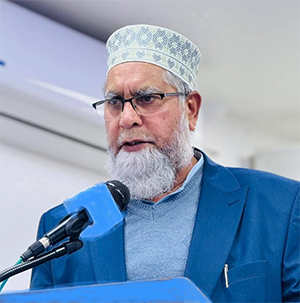
Prof Masood Akhtar Hazarvi
The sanctity of the Holy Kaaba, the Sacred Mosque in Makkah, the blessed resting place of the Messenger of Allah ﷺ, and the Prophet’s Mosque in Madinah are not granted by any government, kingdom, or regional power. Rather, their sanctity has been established by the Lord of the Universe Himself and by His beloved Messenger ﷺ. The Holy Qur’an explicitly declares that whoever enters the Sacred Sanctuary shall be secure. The Prophet ﷺ also prayed: “O Allah, make Madinah beloved to us as You have made Makkah beloved to us, or even more beloved.” (Sahih al-Bukhari, Sahih Muslim)
For this reason, throughout history, serving and protecting the Two Holy Sanctuaries has been regarded by the Muslim Ummah as a great religious responsibility and an honour. From the era of the Prophet ﷺ through the periods of the Rightly Guided Caliphs, the Umayyads, the Abbasids, and the Ottomans, political authority changed hands many times, yet one principle remained constant: the Two Holy Sanctuaries were never regarded merely as the private possession of a particular nation or government; rather, they were considered a trust belonging to the entire Muslim Ummah. The security, sanctity, and dignity of these sacred places transcend political interests and regional disputes, and the responsibility to protect them has remained an essential part of the collective religious consciousness of Muslims. The question, therefore, arises: what circumstances confront this sacred trust today, a trust whose protection remained above political changes for centuries? The answer lies partly in the political fragmentation of the twentieth century, which inflicted a deep wound upon the unity of the Muslim Ummah.
The abolition of the Ottoman Caliphate and the intervention of colonial powers severely damaged the political unity of the Muslim world. The secret Sykes–Picot Agreement, concluded between Britain and France on 16 May 1916, became a significant expression of plans to divide the Arab territories of the Ottoman Empire according to their respective interests following the anticipated defeat of the Ottoman Empire in the First World War. This agreement, together with the borders and political arrangements that followed, contributed to the formation of state structures in which external interests were often more prominent than local historical, tribal, and religious realities. Although the establishment of the Organisation of Islamic Cooperation in 1969 represented an acknowledgement of the need for a common platform for the Muslim world, regrettably, this platform has often remained limited to formal statements rather than developing into effective collective action. As a result, many regions of the Muslim world remain trapped in a complex web of mutual disputes, regional rivalries, and external interventions, the consequences of which affect the peace and stability of the entire Ummah. One tragic manifestation of this political vacuum and fragmentation can be seen today in Yemen and Saudi Arabia.
The present situation in Yemen is a painful example of this broader crisis. Following the Houthi takeover of Sana’a in 2014, the resulting civil war led to a Saudi-led military intervention in 2015, after which the region endured prolonged conflict, destruction, and humanitarian suffering. Millions of Yemenis have been affected by hunger, disease, and displacement. This conflict is not merely a confrontation between two sides; it is also connected with regional rivalries, external interventions, arms interests, and the strategic geographical importance of maritime routes. In recent days, reports of a drone attack near Makkah have deepened concerns that if the effects of regional tensions begin to reach the security of the sacred places, the entire Muslim Ummah must respond with extraordinary seriousness. The security of the Two Holy Sanctuaries cannot become a subject of political dispute. It is a shared responsibility of the entire Ummah and requires religious
