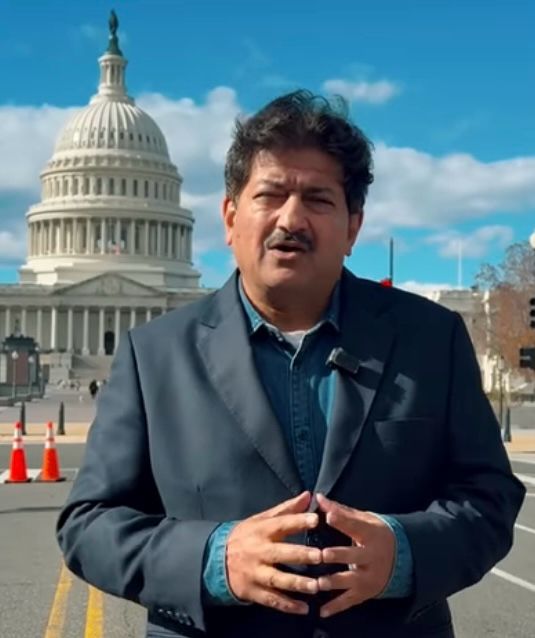
Hamid Mir
Hamid Mir
Three days are very important in the political struggle of Jammu and Kashmir. The first is March 23, the second is July 13 and the third is August 14. To understand the importance of these three days, let us consider July 21, 1924, as the backdrop of the peaceful demonstration in Srinagar by thousands of Kashmiri workers working in silk factories. The owners and officers of these factories were all Hindus who received huge salaries while the Muslim workers received only four and a half annas per day. Against this injustice, the Kashmiri Muslim workers took out a procession with their children and demanded an increase in wages. All the workers who peacefully demonstrated were arrested. This demonstration shows the political awakening among Kashmiri Muslims which began with the establishment of the Young Men’s Muslim Association in Jammu in 1923. After that, in 1929, a movement against state taxes started in the Poonch region. On March 23, 1931, the British government hanged a freedom fighter Bhagat Singh in Lahore. On the same day, the Young Men’s Muslim Association and Mirwaiz Muhammad Yusuf Shah also strongly condemned the execution and held protest demonstrations the next day. A few days after the execution, Eid-ul-Adha came on April 29, 1931.
The Muslims of Jammu were offering Eid prayers in Shalamar Bagh. When Maulana Muhammad Ishaq mentioned the cruelty of Pharaoh and Nimrod in his sermon, Lala Khem Chand, an inspector of the Dogra police presents there, stopped the sermon. On that day, the Young Men’s Muslim Association held a meeting in the Jamia Masjid, Jammu and demanded the dismissal of Lala Khem Chand. On June 4, 1931, a Hindu inspector Lambo Ram insulted the Quran in the Central Jail, Jammu. On June 6, a strike was called in Jammu against this incident. The protest spread from Muzaffarabad and Rawalakot to Mirpur. On June 5, 1931, a large meeting was held at the Khanqah-e-Moalla in Srinagar against the desecration of the Quran. In this meeting, a Pashtun youth, Abdul Qadeer, made a fiery speech against the Dogra government, after which he was arrested. The trial against Abdul Qadeer was held in the Central Jail in Srinagar instead of in a regular court. Thousands of Kashmiri Muslims gathered outside the Srinagar Central Jail and started shouting slogans in favour of Abdul Qadeer. It was July 13, 1931, prayer time when the Muslims climbed the prison wall and started chanting the call to prayer, they were shot at. 22 Kashmiri Muslims were martyred in this firing, and this day was later declared as Kashmir Martyrs’ Day. After this incident, martial law was imposed in Srinagar. All the important Kashmiri leaders, including Chaudhry Ghulam Abbas and Sheikh Abdullah, were arrested.
On August 3, all the arrested leaders were released, but Abdul Qadeer was sentenced to five years in prison. Against these events, a meeting was held on 14 August 1931 in the garden outside Mochi Gate in Lahore, in which Allama Iqbal announced the Kashmir independence movement. On that day, “Kashmir Day” was also celebrated in many other cities. On 14 September 1931, Mirwaiz Maulana Muhammad Yusuf Shah issued a fatwa of jihad against the Dogra government. All this happened in just six months.
On March 23, the entire state of Jammu and Kashmir protested the hanging of Bhagat Singh, then a movement against the desecration of the Quran began, on July 13, 22 Kashmiri Muslims were martyred, and on September 14, a fatwa of jihad was issued from Srinagar against the Dogra government. These dates clearly show that the All-India Muslim League had not yet formally demanded a separate homeland, but the freedom movement had already begun in Jammu and Kashmir. Several Kashmiri leaders, including Chaudhry Ghulam Abbas and Sardar Fateh Karelvi, came to Lahore and consulted Allama Iqbal and founded a political party called the All–Jammu and Kashmir Muslim Conference in 1932.
In 1934, elections were held for the first time in the state of Jammu and Kashmir, and the Muslim Conference won all the Muslim seats. In 1939, Sheikh Abdullah dissolved the Muslim Conference and formed the National Conference. In 1945, Sheikh Abdullah made Pandit Jawaharlal Nehru the chief guest of the annual session of the National Conference and thus the National Conference took a stand on par with the Congress. On the other hand, on 23 March 1940, a delegation of the Muslim Conference participated in the session of the All-India Muslim League in Lahore, in which Jammu, Srinagar, Muzaffarabad, Poonch and Mirpur were fully represented and thus the Muslim Conference openly stood with the Muslim League. In 1944, Quaid-e-Azam Muhammad Ali Jinnah visited Srinagar. He invited Sheikh Abdullah to return to the Muslim Conference, which Sheikh Abdullah refused to accept. On 17 June 1944, Quaid-e-Azam Muhammad Ali Jinnah was the chief guest of the annual session of the Muslim Conference in Srinagar. These are the events against the backdrop of which on 19 July 1947, the Muslim Conference passed a resolution for the accession of Pakistan in its session in Srinagar. According to Professor M. Nazir Ahmed Tashna’s book “History of Kashmir (History of Kashmir 324 BC to 2021)”, the meeting held at the residence of Sardar Ibrahim Khan was presided over by Chaudhry Hamidullah Khan, while Chaudhry Ghulam Abbas, Dr. Ghulam Ahmed Jarrah, Colonel Ali Ahmed Shah and Chaudhry Muhammad Rafiq from Jammu, Haji Muhammad from Poonch, Muhammad Ali Kanwal from Muzaffarabad, Khwaja Ahmedullah Raza from Srinagar, Mirza Faqir Muhammad from Rajouri, Chaudhry Noor Hussain, Professor Ishaq Qureshi, Khwaja Ghulam Mohiuddin from Sopore and Muslim representatives from every part of the state were among those who passed the resolution to join Pakistan. Pakistan came into existence on August 14, 1947, but Kashmiri Muslims had become Pakistanis long before 14 August.
After the establishment of Pakistan, such circumstances arose that the leaders who passed the July 19 resolution became supporters of autonomous Kashmir, but they were not opponents of Pakistan. The historical fact is that the Kashmiri freedom movement It had started on 14 August 1931. Even today, Kashmir Martyrs’ Day is celebrated on 13 July in all parts of the state of Jammu and Kashmir. These are the martyrs who were martyred in Srinagar 16 years before the formation of Pakistan. Unfortunately, today some Muslim League ministers in the Pakistani government claim that they do not consider the people of Azad Kashmir to be fully Kashmiris because their struggle is less than that of the people of occupied Kashmir and their language is also different. Look at the long list of those who passed the resolution of accession to Pakistan on 19 July 1947, representing every region of the state from Srinagar to Jammu and from Mirpur to Muzaffarabad. They included people speaking every language. Kashmir Martyrs’ Day is celebrated on 13 July not only in Srinagar but also from Rawalakot and Bagh to Neelum Valley and Jammu.
The incompetent ruling class of Pakistan, ignorant of the history of Kashmiris, should not forget that in 1987, rigging in the state elections of occupied Jammu and Kashmir gave rise to armed resistance against the Indian government. Syed Yousuf, an election candidate from Srinagar When Shah was rigged, he emerged as Syed Salahuddin for the armed resistance. The mistake that the Indian government made in occupied Jammu and Kashmir should not be made in Azad Kashmir. The use of force will give rise to more rebellion in Kashmir. If you do not believe, ask Syed Salahuddin. Rigged elections will give rise to more resistance. For the sake of millions of Kashmiri martyrs, do not take the path of intimidation and rigging in Azad Kashmir.