Hamid Mir
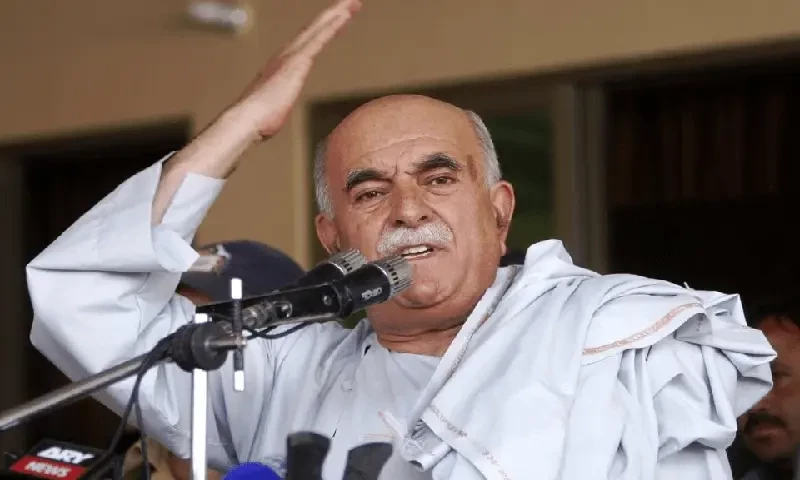
Appointing Achakzai as the opposition leader in the National Assembly means that an attempt will be made to run the current government arrangement without any major face change. Friends of PTI are right to say that Achakzai becoming the opposition leader is a major achievement of Imran Khan, who is imprisoned in Adiala Jail, because he was nominated for the opposition leader by prisoner number 804 from the jail. On the other hand, the PML-N’s powerful men are clapping and saying that Imran Khan has made our job easy because if the opposition leader had come from PTI, he would have done what Omar Ayub Khan used to do. There was not only a communication gap between Omar Ayub Khan and the government, but also a strong dislike for each other. The reason was that Omar Ayub Khan had left the PML-N. Apart from this, he was very critical of the interference of his father and grandfather’s former institution in politics and this criticism hurt the authorities more because Omar Ayub Khan is the grandson of Pakistan’s first military dictator General Ayub Khan and a year ago, the Movement for the Protection of the Constitution was formed in General Ayub Khan’s house in Islamabad. In this house, Mahmood Khan Achakzai had repeatedly explained to the PTI members that a way of dialogue would have to be found with all stakeholders including Asif Zardari and Nawaz Sharif to protect and restore the constitution. Achakzai Sahib repeatedly spoke of a Grand National Dialogue from the platform of the Movement for the Protection of the Constitution and said that Nawaz Sharif should play some role as an elder. Achakzai kept on annoying Imran Khan’s supporters by declaring Nawaz Sharif as his elder, but the PML-N members felt that Achakzai should go with them or not, but the government could sometimes take a little walk with them. Nawaz Sharif and Shahbaz Sharif still respect him very much due to their old friendship. How can Nawaz Sharif forget that Achakzai not only joined the political alliance he formed in London during the rule of General Pervez Musharraf, but also stood by Nawaz Sharif later?
In 2014, when Imran Khan occupied D-Chowk in Islamabad and staged a long sit-in, Khan often made fun of Mahmood Khan Achakzai’s chader during the sit-in. The reason was that Achakzai’s elder brother, Muhammad Khan Achakzai, was the governor of Balochistan. Imran Khan realised his mistake ten years later. By then, it was too late. In 2024, Imran Khan made Mahmood Khan Achakzai his presidential candidate. Everyone knew that Asif Ali Zardari would easily become the President of Pakistan again, but by making Achakzai the presidential candidate, Imran Khan atoned for the mistake he made in D-Chowk in 2014. Achakzai stood by the Constitution in 2014 and he still stands by the Constitution today. One can disagree with him on many issues, but in every period of oppression, he shows more resilience than he can handle. After becoming the opposition leader in the National Assembly, the most difficult test of his political life has begun. The government will try to make him the opposition leader and get him to withdraw the call for the February 8 protest. It should be noted that the call for the wheel-jam strike on February 8 was not given by the Tehreek-e-Insaf but by the Tehreek-e-Tahafuz-e-Ain. There is no possibility of this call being withdrawn because the parliament in which Mahmood Khan Achakzai has been given a position has already taken 27, not 26, blows to its reputation. Politics is now moving out of the parliament and onto the streets. The rapidly changing global situation has also forced the government to reconsider its policy. Until recently, US President Trump and our powerholders seemed to be in a state of disarray. In Sharm el-Sheikh, we added such earth-shattering twists to Trump’s praise that many Americans, overcome by excessive emotions, brought “tears to their eyes”, but many Pakistanis “cried tears of blood” at these praises. Then Pakistan made two decisions that dealt Trump a serious political blow. The first decision was to refuse to send Pakistani troops to Gaza. The second decision was to issue a statement of condemnation at the United Nations over the arrest of the Venezuelan president. In response, the US added Pakistan to the 75 countries whose citizens have had their immigrant visas suspended. Pakistani decision-makers are examining the joint role of the US and Israel in Iran from every angle. They are not afraid, but rather certain that after the change of government in Iran, Pakistan will be the next target. The US does not want more political turmoil in Pakistan, but Israel will try to bring Pakistan and the US face to face. The US establishment has been looking for ways to limit Pakistan’s nuclear program for a long time. Today, Israeli Prime Minister Netanyahu is trying to improve relations between Trump and Narendra Modi. If this attempt succeeds, it will be an attempt by Netanyahu and Modi to use Trump against Pakistan’s nuclear programme. It is no secret that the Israeli secret service Mossad was behind the recent violent protests in Iran. There is a fear circulating in the conspiracy circles of Islamabad that the kind of political chaos that was spread in Iran can also be spread in Pakistan so that the Pakistani government is forced to support the US, at least on the issue of Iran. Last week, PPP Chairperson Bilawal Bhutto Zardari presented the case of Sindh in front of foreign diplomats and journalists at the Presidential Palace. It was not only about Sindh but also about protecting the 18th Amendment. When this program ended, during tea, a diplomat asked me whether there have ever been protests in Pakistan like the ones happening in Iran today? I was surprised to hear this question and inquired what you wanted to ask. The diplomat asked, “Has political protests ever been used to bring about regime change in Pakistan?” I nodded in the affirmative and said, “Read Zulfikar Ali Bhutto’s book, ‘If I am Assassinated,’ in which he wrote while sitting in jail that the movement against his government in 1977 was backed by US dollars.” He also presented some evidence in the book. The diplomat asked where he could get this book. I told him the name of a bookstore in Islamabad but also explained that regime change in Pakistan is not possible unless the political leadership and the military leadership are suspicious of each other. Achakzai’s test now is that he must protect himself from the government’s influence and keep the opposition movement away from the foreign agenda. The Constitution of Pakistan is not only the target of undemocratic forces, but also of some foreign powers, which Achakzai must explain in detail.”