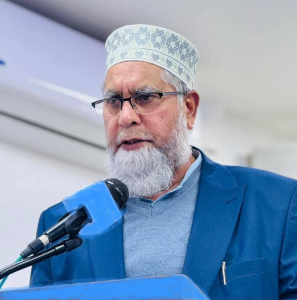
By Prof Masood Akhtar Hazarvi
There was a time when our society stood as a shining symbol of modesty, chastity, moral purity, and self-respect. The first lesson imparted in homes was one of ethics and good character. Courtesy in speech, gentleness in tone, purity in gaze, and integrity in conduct were clearly visible. Modesty was not confined to a particular dress, gender, or ritual; rather, it was a collective state of being that permeated the entire society. Whether man or woman, old or young, everyone possessed an inner restraint and moral dignity that kept them away from wrongdoing. In those days, honor, truthfulness, trustworthiness, and service were regarded as a person’s true identity. But the passage of time has altered our values profoundly.
Today, display has overpowered character, fame has devoured dignity, and fleeting attention has weakened lasting moral foundations. Social media and modern culture may project an image of progress, but they have stripped hearts of the simplicity and spirituality that once defined a righteous society. Today, a person’s worth is measured not by ethics or knowledge, but by views, likes, and followers. This is the stage where conscience falls silent and society begins to laugh at immorality.
The recent incident of Umaira’s video has laid bare this decline. The tragedy is not merely that an inappropriate video was made or went viral; the real sorrow is that millions watched it, forwarded it, and commented on it. We turned someone’s lapse, a family’s honor, and a human life into entertainment. We forgot that modesty is a part of faith, and that the Prophet Muhammad ﷺ said: “A Muslim is the one from whose tongue and hand other Muslims are safe.” Today, our “hand” is the mobile phone and our “tongue” is the social media platform. Through these very means, we attack the emotions, honor, and lives of others.
The viral culture of social media is a mirror reflecting our intellectual and moral decline. Automated systems—algorithms—promote and amplify only what is sensational or emotionally provocative, while serious discussion, reformative messages, and scholarly discourse fade into the background. As a result, corruption becomes commonplace and goodness is labeled as boring. Our priorities shift, and we fail to realize that what we perceive as “entertainment” is, in fact, a form of moral destruction.
Islam laid the foundation of society upon pure character. A society improves when individuals safeguard their hearts, gazes, and tongues. But today, religion has been confined merely to rituals. We pray, yet do not refrain from lying; we recite the Qur’an, yet its reflection does not appear in our conduct. This contradiction is the root of our collective weakness. If knowledge, worship, and morality were to support one another, society would naturally move in the right direction.
Parents take pride in modernity but have removed lessons of modesty and shame from the home environment. Educational institutions impart knowledge, yet character-building has been relegated to a secondary status. Scholars preach, but audiences are no longer willing to listen. This vacuum has weakened our values.
The Qur’an clearly declares: “Indeed, Allah does not change the condition of a people until they change what is within themselves.” Within this verse lies hope—that if we choose to correct our attitudes, priorities, and upbringing, we can once again adopt the path of light. History teaches us that moral decay erases the rise of nations. The Roman Empire fell to indulgence, Greece declined with the erosion of justice, and the downfall of Andalusia began when the bond between knowledge and character was severed. When principles weaken, when modesty is labeled outdated, when sin is considered bravery and virtue is deemed weakness, nations crumble despite possessing knowledge, power, and wealth.
Today, Pakistan stands at this perilous crossroads. In the name of freedom, the new generation is forgetting boundaries. Under the guise of modernity, the veil of modesty is being shed in dress, language, relationships, and lifestyle. Most of the day and night is spent on social media, where there is neither constructive dialogue nor intellectual depth. As a result, the moral and psychological balance of the youth is being disturbed, and an entire generation is gradually losing inner peace.
Yet, it is not too late. If we elevate upbringing within our homes to the status of worship, make character-building essential alongside education, promote moral responsibility in the media, and transform our religion from mere words into lived practice, circumstances can change. Modesty is not just about veiling or clothing; it is the spirit of faith—a state that keeps the heart awake, makes sin shameful, and renders virtue beautiful. When modesty is alive, the heart trembles before committing a wrong; when modesty dies, even sin begins to seem trivial.
The real battle today is not fought with swords on battlefields, but on screens. If we fail to raise the banner of faith, morality, and modesty there, future generations will remember us as a cautionary tale. But if we rekindle the inner lamp, awaken our conscience before clicking, and remember faith before watching, this very nation can become a new source of light. May Allah grant us the insight and courage to be free yet within limits, modern yet moral, and to use technology not as a source of evil but as a means of goodness. Ameen.