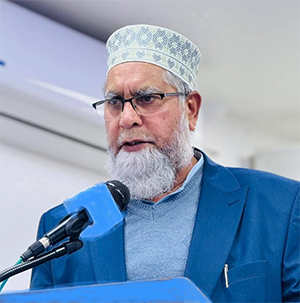
Prof Masood Akhtar Hazarvi
Life is not merely the beating of the heart or the taking of breath; it is a precious and sacred trust given to humanity by the Creator of the universe. When a society begins to lose respect for this trust, its civilisation gradually weakens. Today, Britain is passing through one such important and sensitive period, in which the definition of life and death is being debated in Parliament, and the issue has now moved beyond books and academic discussions into ordinary people’s homes.
The law currently under discussion in Britain is officially known as the Terminally Ill Adults (End of Life) Bill, and is commonly referred to as the Assisted Dying Bill. It was introduced in the House of Commons in October 2024 by Labour MP Kim Leadbeater. Its purpose is to allow an adult over the age of 18 in England and Wales, who has been diagnosed by two independent doctors as suffering from a terminal illness and is believed to have only six months left to live, to request legal assistance in ending their life. The Bill also proposes the establishment of a new body and a panel of experts to oversee the process.
The debate surrounding this legislation has been highly emotional and heated in the British Parliament. The Government has maintained a neutral position on the matter. The Bill received its initial debate in November 2024 and, after passing through several stages, was approved by the House of Commons in June 2025 by an extremely narrow majority of just 23 votes. Such a small majority demonstrated how deeply divided Parliament itself remains over the possible consequences. Later that same month, the Bill was introduced in the House of Lords, where detailed discussions took place in September 2025 and members expressed serious concerns. It remains to be seen what amendments the House of Lords will make and what final form the legislation will take.
Supporters of the Bill describe it as a matter of personal freedom and a dignified death. They argue that people should have the right to avoid a painful death. On the surface, this argument may appear deeply compassionate, but it conceals a serious social danger. When a state makes the path to death easier and cheaper for a person who is weak, elderly, disabled, lonely or experiencing financial hardship, instead of providing the best possible treatment, nursing care and financial support, that person may gradually begin to feel that they are a burden on their family and society.
Britain’s healthcare system, the NHS, is already under considerable pressure, and thousands of patients struggle to receive timely care. In such circumstances, when a patient sees a painful and lonely life on one side and an easier route towards death offered by the state on the other, their decision can never be regarded as entirely free from pressure. Mental health professionals often point out that when a patient says, “I do not want to live anymore,” the underlying message is not always a desire for suicide. It may instead be a quiet cry for help arising from depression, intense fear, loneliness or neglect by loved ones. If the law gives this painful cry the name of freedom and authorises death, it will not be compassion. It may become a silent form of social pressure that places the lives of the most vulnerable members of society at risk.
In contrast to this intellectual confusion and moral debate, Islam’s message is clear and illuminating. Allah Almighty says: “And do not throw yourselves with your own hands into destruction.” He also says: “And do not kill yourselves. Indeed, Allah is ever Merciful to you.” According to Islam, a human being is not the absolute owner of their life but a trustee entrusted with it. The Prophet Muhammad ﷺ said: “None of you should wish for death.”
No matter how severe the pain, how incurable the illness or how close a person may be to the end of life, Islam does not recognise the right of an individual to deliberately end their own life. In Islam, suicide and deliberately causing one’s life to be ended through another person are both forbidden and unlawful.
However, Islam does not leave a person suffering in isolation. The faith makes a clear distinction between relieving suffering and ending the life of the person who is suffering. Providing the best possible medical treatment, caring for the patient, administering permissible medication to reduce pain, offering comfort and praying for them are all acts of great virtue and worship. By contrast, saying that life has become a burden and should therefore be ended is not medicine; it is a misguided philosophy of death.
Islamic jurisprudence has made an important distinction in this delicate matter. Under the proposed law, deliberately administering a drug or poison with the intention of killing a patient would be unequivocally forbidden in Islam and equivalent to killing. A separate matter is the withdrawal of futile treatment. If qualified doctors determine that treatment has become entirely ineffective, and that a ventilator or other artificial equipment is merely prolonging the natural process of dying for a limited period, it may be permissible to withdraw such artificial support. This is not the same as killing someone; rather, it is refraining from unnecessarily prolonging the dying process through artificial means. Legislators in the House of Lords would do well to understand this subtle but fundamental distinction.
This Bill is not merely a matter concerning the wording of a law book; it is a test of the conscience of Britain as a whole. This is a multi-faith and multicultural country, where hospitals are sustained by the dedication of thousands of Muslim, Christian, Jewish, Hindu and other healthcare professionals, doctors, nurses and care workers. For many of these people, life is a sacred trust. If they are legally compelled to participate in such an act, it would represent a serious violation of their religious conscience. A genuine democracy is one that respects the majority while also providing strong protection for the conscience of minorities.
The true greatness of human civilisation does not lie in how many quick and easy routes to death it creates for its citizens. Its true dignity lies in how peacefully, safely, lovingly and respectfully it can make the final moments of its most vulnerable citizens. Britain’s Parliament now faces a historic decision: how does it wish to be remembered? As an institution that stood as a protector of life, or as one that opened the door to eliminating people suffering from pain instead of addressing the causes of that pain?
We need a society in which every sick person can have the firm assurance that the state will not help them to die, but will support them in living with dignity until their final breath. For life is a trust from Allah, and protecting it is a shared moral responsibility for us all.z