
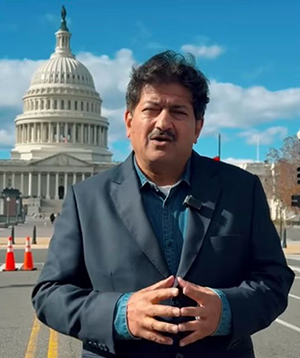
Hamid Mir
Never thought that Maulana Fazlur Rehman would also join those demanding the release of Imran Khan. I know both since 1988. This was the time when Pakistan’s military president, General Zia-ul-Haq, dismissed his own prime minister, Muhammad Khan Junejo, on allegations of corruption. The then Chief Minister Punjab Nawaz Sharif sided with General Zia instead of standing with his party Muslim League Prime Minister Junejo. After dismissing Junejo, General Zia decided to include Imran Khan in the new government. Imran Khan retired from Test cricket in 1987, but on the request of General Zia, he withdrew his retirement. General Zia believed that if Imran Khan joined the new government, his damaged reputation would get a lot of support.
I was new in journalism. I got the news that Imran Khan has been offered to join the new government. When I contacted Imran Khan to confirm this news, instead of answering, he asked what do you think I should do? I immediately said you refuse. After listening to my advice, Khan Sahib said, “Okay, I will refuse, but don’t make news of this refusal, otherwise it will be very difficult.” I could not hold this news for long and one day I spat out the news. Khan got angry. If Imran Khan had become part of the government in 1988, he would not have won the World Cup for Pakistan in 1992.
Around that time, I interviewed a German scholar regarding the ‘Silk Letter Movement’ (Reshmi Rumal Tehreek). He explained that during the First World War, scholars from the Indian subcontinent with the assistance of Afghanistan, Turkey, and Germany had devised a ‘Berlin Plan’ to resist the British colonial government. The Silk Letter Movement was a component of this Berlin Plan, had it succeeded, India might have gained independence from British imperialism as early as 1916. Maulana Fazl-ur-Rehman read this interview and, during a meeting in Lahore, spoke very highly of it. Subsequently, he arranged for a four-volume work by Maulana Syed Muhammad Mian, titled “Ulema-e-Hind ka Shandaar Maazi” (The Glorious Past of the Scholars of India), to be sent to me through an associate, so that I might gain a deeper understanding of the Silk Letter Movement. This marked the beginning of my association with the Maulana.
In 1990, Iraqi President Saddam Hussein invaded Kuwait. In response, the United States deployed troops to various Gulf states to defend Kuwait. Meanwhile, demonstrations in support of Saddam Hussein erupted across Pakistan. One day, Shahid Sheikh, a sports reporter for the Lahore edition of the “Daily Jang”, brought forward a statement attributed to Imran Khan. “Whoever is not with Saddam is not a Muslim.” This statement caused quite a stir, as the Pakistani government had aligned itself with Saudi Arabia rather than Saddam Hussein. It was the first time I heard Maulana Fazl-ur-Rehman express praise for Imran Khan. Although my own personal view regarding Saddam differed, it became clear that both Imran Khan and Maulana Fazl-ur-Rehman shared a critical stance toward the United States. In 2002, another military ruler, General Pervez Musharraf, attempted to legitimise his unconstitutional regime through elections. At that time, Imran Khan served as the sole representative of his party in the National Assembly.
Asif Ali Zardari, while imprisoned in Adiala Jail, Rawalpindi, initiated an effort to install Maulana Fazl-ur-Rehman as Prime Minister, positioning him against General Musharraf’s preferred candidate, Mir Zafarullah Jamali. At that time, Benazir Bhutto was in exile in Dubai, and Nawaz Sharif was in Saudi Arabia. Benazir Bhutto refused to support the Maulana, but Nawaz Sharif endorsed him as a candidate for the premiership. Among those who cast their votes for the Maulana for the office of Prime Minister was not only the Pakistan Muslim League (N) but also Imran Khan. I recall that during that period, if anyone insolently referred to Maulana Fazl-ur-Rehman as “Maulana Diesel,” Imran Khan would confront them. Yet, when Imran Khan himself became Prime Minister in 2018, he began calling the Maulana “Maulana Diesel” during his political rallies. The animosity between Khan and the Maulana grew to such an extent that the Maulana labelled Imran Khan a “Zionist agent.” In 2019, Maulana Fazl-ur-Rehman announced a “long march” against Imran Khan’s government.
The then-Army Chief, General Qamar Javed Bajwa, would frequently summon journalists to claim that Maulana Fazl-ur-Rehman was working for the British intelligence agency, MI6. I once asked General Bajwa, “Why don’t you present concrete evidence against the Maulana and initiate legal action?” General Bajwa would immediately change the subject. On one hand, Bajwa would extol the benefits of establishing friendly relations with Israel, while on the other, he would brand Maulana Fazl-ur-Rehman an agent of the British.
Subsequently, the Pakistan Muslim League (N) and the Pakistan People’s Party decided to leverage Maulana Fazl-ur-Rehman against Imran Khan. The Pakistan Democratic Movement (PDM) was formed under the Maulana’s leadership, and a campaign was launched against Imran Khan’s government. Khan tasked all intelligence agencies as well as the National Accountability Bureau (NAB) with uncovering evidence of corruption by the Maulana. General Faiz Hameed, the then-head of the ISI, would personally coordinate with a select group of journalists to plant “fake news” targeting the Maulana, effectively initiating a “media trial” against him. However, this media trial had no impact on the Maulana. Meanwhile, General Bajwa’s desire to foster ties with Israel created a rift between him and Imran Khan. Instead of granting Bajwa another extension, Khan decided to appoint General Faiz Hameed as the new Army Chief. In 2022, the opposition capitalized on the growing discord between General Bajwa and Imran Khan, successfully ousting Khan from the Prime Minister’s House through a vote of no-confidence. Following his removal from power, Imran Khan came to realize the significance of Maulana Fazl-ur-Rehman; he made several attempts to forge an alliance with him, but these efforts proved unsuccessful.
Concurrently, the new ISI chief, General Nadeem Anjum, worked to distance the PML-N and the PPP from the Maulana. Ironically, the very same Maulana Fazl-ur-Rehman who, in 2010, had successfully brought together religious scholars from across the country at Jamia Ashrafia, Lahore, to endorse a unanimous declaration against terrorism was now being branded an accomplice of terrorists. In the wake of that declaration against terrorism and militancy, the Maulana faced a series of consecutive suicide attacks in Swabi, Charsadda, and Quetta, yet he remained steadfast in his opposition to the use of militancy within the political sphere. It is true that both Maulana Fazl-ur-Rehman and Imran Khan favoured negotiations with the Taliban government in Afghanistan, yet, despite this common ground, the Maulana refrained from becoming a political ally of Imran Khan. There was a profound lack of trust between the two, but ultimately, certain ill-advised decisions by the Shehbaz Sharif administration have brought them closer together. The Maulana states that Imran Khan along with all the women of his family has been imprisoned. Furthermore, Governor’s Rule has been imposed in Khyber Pakhtunkhwa. Under these circumstances, he argues, there is no alternative but to resist this oppression.
Currently, social media is flooded with fabricated videos targeting Maulana Fazl-ur-Rehman, and he is facing threats of arrest. Having already been arrested eleven times throughout his political career, he remains prepared for a twelfth. The credit for bringing the Maulana and Khan Sahib together goes to Shehbaz Sharif. Just as Khan realized the significance of the Maulana only after being ousted from power, the Pakistan Muslim League-N (PML-N) will likely only recall the Maulana once they, too, are out of government though it is doubtful that the Maulana will fall into their trap again.
