
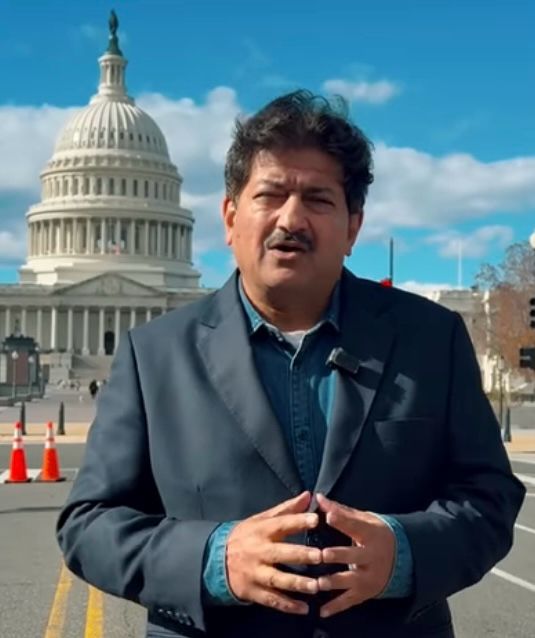
Hamid Mir
The 21-hour long talks between the US and Iran in Islamabad have not yielded any results so far. The Indian media is celebrating the failure of the talks, but there are some Indian journalists who are congratulating Pakistan for hosting these talks. In front of me, there is a conversation between two Indian journalists. In this conversation, both the female journalists express deep regret over the behaviour of their government and the Indian media on the historic talks between the US and Iran in Islamabad and try to convince their compatriots that the success of these talks will benefit everyone in the world, including India. The first very high-level talks between the US and Iran after 1979, thanks to Pakistan’s efforts in Islamabad, were discussed all over the world, but these talks were ridiculed on many Indian TV channels only because of why these talks were being held in Pakistan. On this irresponsible and unprofessional behaviour of the Indian media, Senior Editor of The Wire, Arifa Khanum Sherwani, spoke to another senior journalist, Nirupama Subramanian. The link of this conversation was sent to me by Mr. Saleem Mansoor Khalid, Editor of the monthly Tarjman-ul-Quran.
I was surprised that Saleem Mansoor Khalid, who belongs to the right wing, gives so much importance to the left-wing Arifa Khanum Sherwani. When I saw Nirupama’s picture in this link, I started listening to this interview. Nirupama was based in Islamabad as a correspondent for ‘The Hindu’ many years ago. She understands Pakistan very well and had come to Islamabad last year to attend a conference. Apart from ‘The Hindu’, Nirupama has also been associated with Indian Express and other Indian newspapers and nowadays writes a column in ‘The Tribune’. In this conversation, Arifa asked Nirupama that we are trying to prove Pakistan a sponsor of terrorism and try to isolate Pakistan diplomatically, but how did Pakistan become the centre of attention of the whole world through the Islamabad talks and how did US Vice President JD Vance reach Islamabad to meet Iranian Parliament Speaker Baqir Qalibaf?
Nirupama Subramanian gave an answer to this important question that I did not hear on the Pakistani media, but this was the real truth. Nirupama said that US President Donald Trump sent JD Vance to Islamabad and the reason for Trump’s trust in Pakistan is India’s Operation Sindhoor. This brave female journalist said that last year, when India started a war against Pakistan in the name of Operation Sindhoor, Donald Trump claimed that he had brought about a ceasefire. Pakistan confirmed Trump’s claim, but the Indian government kept denying this claim. This was the moment when Trump and Pakistan’s political and military leadership came very close to each other.
Then the Pakistani government won Trump’s heart by nominating him for the Nobel Peace Prize, and thus Pakistan became very close to China as well as the United States. After the Indo-Pakistan war of May 2025, when Israel and the United States attacked Iran, Pakistan condemned the war. Thus, Pakistan also won the heart of its neighbour Iran, while the Indian government was expanding its friendship with Israel. On February 28, 2026, when Israel and the United States attacked Iran once again, Pakistan started trying to stop this war. When Nirupama Subramanian congratulated Pakistan for stopping this war and then holding US-Iran talks in Islamabad, Arifa Khanum Sherwani was also surprised. In my poor opinion, Nirupama Subramanian’s congratulations to Pakistan on the Islamabad talks are very important and this congratulations show that the Indian media does not represent the entire Indian nation. Just as we do not hear some popular voices from Khyber Pakhtunkhwa and Balochistan in the Pakistani media, similarly, the voices of those who talk about peace with Pakistan are rarely heard in the Indian media. Nirav Modi, who showed courage and intellectual integrity, took many risks by congratulating Pakistan for holding peace talks. RSS and BJP people will call him a traitor. The same happens in Pakistan too. Those who do not like the state and speak the truth are called Indian agents. Former Chief Ministers of occupied Jammu and Kashmir, Farooq Abdullah and Mehbooba Mufti, have also praised Pakistan for holding talks in the US and Iran. The praise of Pakistan by these two Kashmiri leaders did not go down well with some people in New Delhi because small-minded people like Dr. Jaishankar in New Delhi fear that if Pakistan’s diplomatic stature continues to rise, Pakistan will soon make the Kashmir issue a part of the global agenda. If a path to permanent peace emerges in the Middle East in the future, then one day a path to resolving the Kashmir issue may also emerge. Israel is a major party in the conflict between the US and Iran. Pakistan does not have diplomatic relations with Israel, so initially Pakistan’s diplomacy was aimed only at bringing about a ceasefire between the US and Iran.
The Indian media described Pakistan as America’s postman and Foreign Minister Jaishankar as a broker, shedding tears over his regrets, but Pakistan changed from a facilitator to a mediator within a few days. The Islamabad talks failed to yield any results. US Vice President JD Vance praised Pakistan generously for organizing the talks – he said before returning on Sunday that we are going back without a deal. Iran says that the US has not shown flexibility in the talks. However, for 21 hours, each side was listened to, and this is a great achievement for Pakistan. Pakistan will try to bring the parties back to the negotiating table. Unfortunately, no agreement could be reached in the 21-hour talks, but such talks do not prove fruitful even in 21 days or 21 weeks. These negotiations continue for many weeks and months, and when an agreement is signed, there are also great difficulties in implementing this agreement. According to the data I have, since 1990, different countries of the world have signed 2146 agreements to resolve their mutual disputes, out of which only six percent have been implemented to date. Pakistan brokered the Doha Agreement between the US and the Afghan Taliban in 2020, which has not yet been implemented. The US and Iran should extend the two-week ceasefire. Include Lebanon in the ceasefire and continue talks somewhere. These talks and their success are needed more by the US than by Iran, which, despite being a superpower, is suffering from diplomatic and political isolation. The American public also wants peace with Iran. The strenuous efforts made by Pakistan to turn the ceasefire into a peace agreement are also being praised in India. Pakistan should continue its efforts and involve more stakeholders in this effort to establish peace in the Middle East. If not today, then tomorrow, America and Iran will have to sign a peace agreement.
